

Tenzin Nyidon
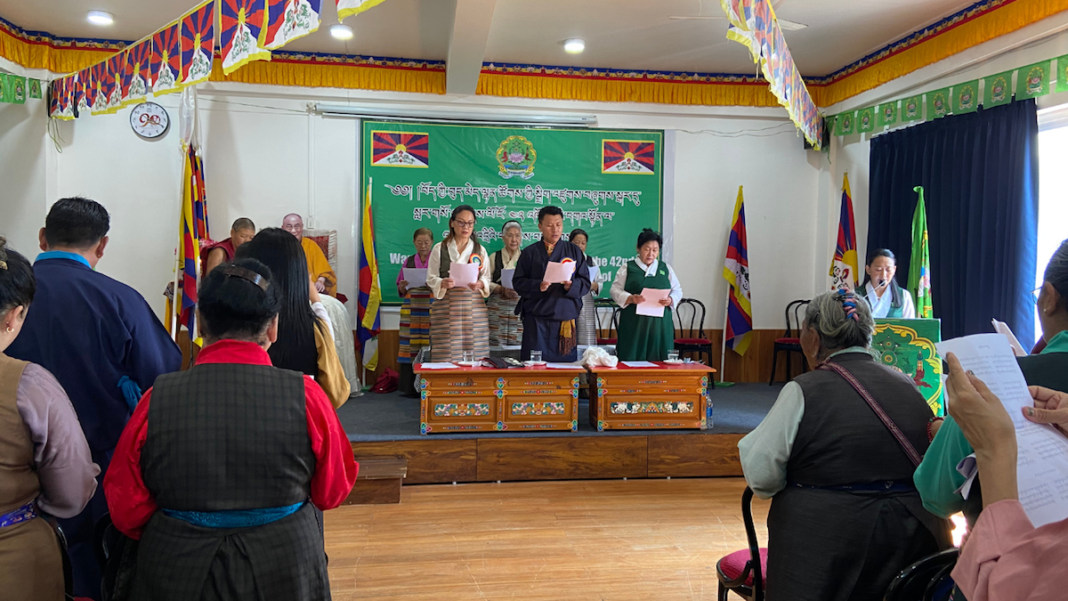
DHARAMSHALA, Sept. 10: The Tibetan Women’s Association (TWA), the only women’s organisation in the Tibetan exile community, on Thursday commemorated the 42nd anniversary of its re-establishment in exile at an event held at the Tibetan Settlement Office in McLeod Ganj, Dharamshala.
The commemorative event was attended by former Tibetan Parliamentarian and President of the Tibetan Nuns Project, Youdon Aukatsang, as the special guest, along with Dharamshala Tibetan Settlement Officer Kunchok Migmar, representatives of the Central and regional TWA, and members of the local Tibetan community.
Addressing the gathering, TWA President Tsering Dolma traced the organisation’s roots to its establishment in Lhasa in 1951 and highlighted the historic mobilisation of Tibetan women on March 12, 1959, under courageous leaders including Pamo (female martyr) Kunsang. She said women continued organising in exile after 1959, with the association reaffirmed in 1960 and women’s cooperative societies and local associations subsequently established across Tibetan settlements. Amid declining participation in the early 1980s, a renewed effort led by Tibetan women in Dharamshala, under the guidance of His Holiness the Dalai Lama, culminated in the association’s formal re-establishment on September 10, 1984, marking the beginning of its subsequent growth into a global organisation.
She reaffirmed the association’s continued commitment to the Middle Way Approach, describing it as a longstanding conviction rooted in dialogue and sustained deliberation. “The Middle Way Approach remains the path the Association walks,” she said, noting that the vision was carried forward by His Holiness the Dalai Lama and the policy adopted by the Central Tibetan Administration (CTA) following years of discussion and collective engagement. She emphasised that the position was not adopted hastily but developed through “sustained discussion and a shared commitment.”
The TWA President condemned China’s recently enacted “Law on Promoting Ethnic Unity and Progress,” which formally came into effect on July 1, 2026, stating that the legislation would intensify efforts to assimilate Tibetans and erode their distinct cultural identity. “On 12 March 2026, the Chinese Communist government adopted the Law on Promoting Ethnic Unity and Progress during a session of the National People’s Congress,” she said, describing the 65-article legislation as inconsistent with its stated objective. According to the TWA, the law has since been used to advance policies that threaten Tibetan language and script, religion, culture, customs, traditions, and historical identity.
The association also paid tribute to the 170 Tibetans in Tibet and exile who have lost their lives through self-immolation, including the late Tibetan independence activist Lobga Rangzen, who self-immolated in front of the United Nations headquarters in New York on July 2, 2026. Remembering his sacrifice, the TWA expressed its “profound gratitude” and extended its deepest solidarity and condolences.
Reflecting on its decades of activism, Tsering Dolma said the association has carried out numerous campaigns and initiatives with the support of the Tibetan public through its central and regional branches. The association reiterated that its work would continue for as long as the Tibetan issue remains unresolved, while calling upon younger Tibetans to assume greater responsibility and take an active role in sustaining the organisation.
“As long as the truth and justice of the Tibetan cause remain unresolved, the Tibetan Women’s Association must continue to exist and carry forward its struggle,” the organisation stated. The association also expressed its gratitude to those who have supported its work and the broader Tibetan movement, reaffirming its commitment to preserving Tibetan identity, strengthening solidarity and advancing the legitimate rights and aspirations of the Tibetan people.
Established in its present form on September 10, 1984, the association has since evolved into a global organisation with 59 branches and more than 21,000 members across different parts of the world, representing Tibetans from all three traditional regions and diverse cultural traditions.

