

Tenzin Nyidon
DHARAMSHALA, Nov. 13: Chinese President Xi Jinping has renewed Beijing’s insistence on bringing Taiwan under its control, declaring that the island’s eventual reunification with mainland China is an “unwavering historical mission” of the Chinese Communist Party (CCP) and warning that there would be no room for Taiwan independence.
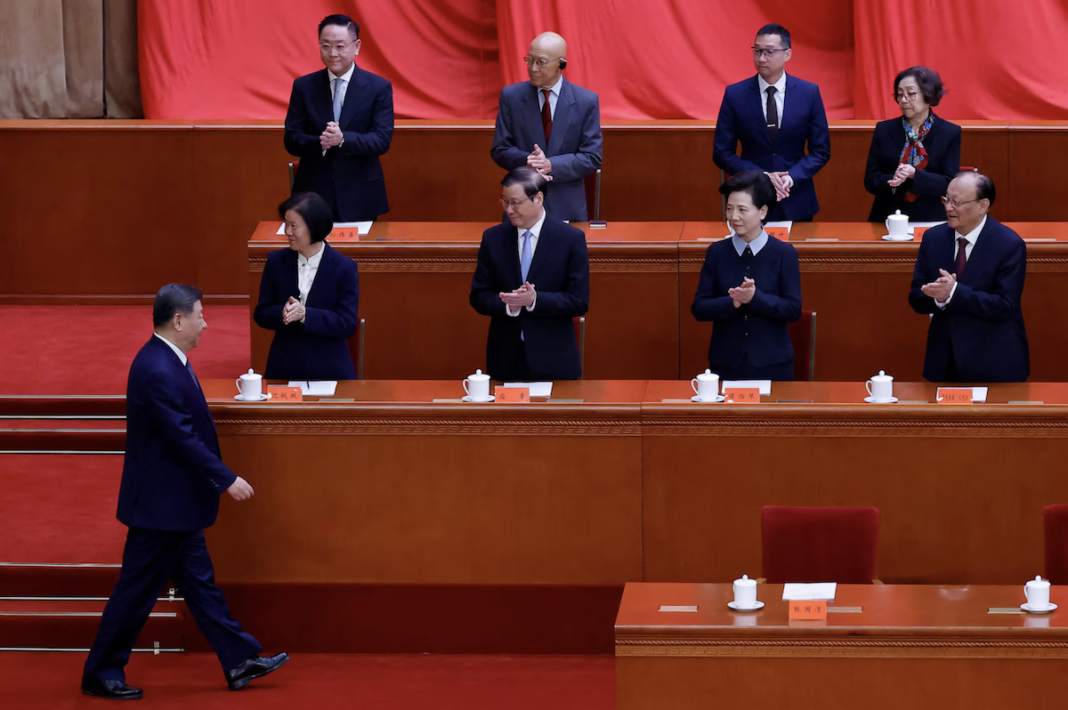
Xi made the remarks on Thursday at the Great Hall of the People in Beijing during a commemorative gathering marking the 160th birth anniversary of Sun Yat-sen, the revolutionary leader who helped overthrow China’s Qing dynasty in the 1911 Revolution and subsequently founded the Republic of China.
“The tide of history cannot be stopped,” Xi said, asserting that the “complete reunification of the motherland must be realised, and it will certainly be realised.” He urged people on both sides of the Taiwan Strait, as well as Chinese communities overseas, to oppose what Beijing describes as Taiwan independence separatist forces and work towards the “peaceful development” of cross-strait relations.
Reiterating Beijing’s longstanding position, Xi said China remained committed to peaceful reunification under the “one country, two systems” framework. He also expressed willingness to engage in dialogue with individuals and groups in Taiwan who support the one-China principle and the 1992 Consensus, while insisting that Taiwan’s independence would not be accommodated.
The remarks drew a firm response from Taipei, with Taiwan’s Mainland Affairs Council urging Beijing to acknowledge the continued existence of the Republic of China and respect the island’s democratic political system.
The council rejected Beijing’s proposed “one country, two systems” arrangement, arguing that it would effectively place Taiwan under the Chinese Communist Party’s rule. It maintained that the People’s Republic of China (PRC) had never exercised sovereignty over Taiwan and that the island’s future must be determined by its 23 million people.
Taipei also criticised Beijing’s invocation of Sun Yat-sen’s legacy, accusing the CCP of appropriating the revolutionary leader’s historical legacy to advance its reunification agenda.
Sun, who is revered in both mainland China and Taiwan, occupies a distinctive place in the competing historical narratives across the Taiwan Strait. While Beijing portrays him as a precursor to its national rejuvenation project, Taiwan regards him as the founding father of the Republic of China, whose government relocated to the island in 1949 following its defeat in the Chinese Civil War.
Xi’s latest remarks come amid persistent military tensions across the Taiwan Strait. Taiwan’s Defence Ministry reported detecting 29 Chinese military aircraft conducting a joint combat readiness patrol alongside Chinese naval vessels around the island on Thursday.
The renewed rhetoric also comes ahead of an expected meeting between Xi and US President Donald Trump on the sidelines of the APEC summit in Shenzhen, adding another dimension to the geopolitical contest surrounding Taiwan’s future.
The issue is particularly sensitive given Washington’s extensive military support for Taipei. Between 2015 and 2025, the United States notified Congress of more than US$39 billion in Foreign Military Sales to Taiwan, while the Trump administration announced an US$11.1 billion arms package in December 2025, one of the largest ever for the island. Washington has also allocated US$1 billion in security assistance for Taiwan in fiscal year 2026, alongside US$300 million in military financing grants.
Beijing has repeatedly denounced American arms sales to Taiwan, viewing them as interference in its internal affairs and a challenge to its sovereignty claims over the island. Washington, however, maintains that its military support is intended to strengthen Taiwan’s self-defence capabilities and preserve stability across the Taiwan Strait.
Beijing considers Taiwan an inalienable part of its territory, while Taipei maintains its democratic self-government and rejects the Chinese Communist Party’s authority over the island.

