

Tenzin Nyidon
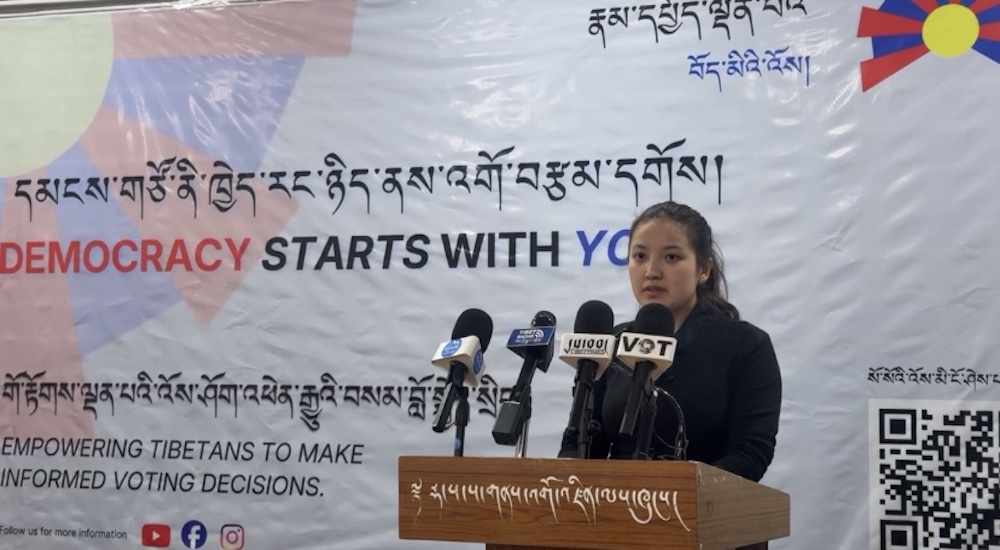
DHARAMSHALA, Jan. 6: SmartVote Tibet, an online voter information platform developed by the Tibetan civil society group Project Democracy, re-launched its website on Monday ahead of the 2026 Central Tibetan Administration (CTA) general elections. The event was held at the Tibetan Community Hall in Dharamshala.
The platform features a uniform questionnaire comprising 33 structured questions designed for both candidates and voters, covering a range of contemporary issues. These include electoral reforms, parliamentary seat distribution, education, healthcare, social welfare, culture, language, and political system, among other concerns facing the Tibetan community.
Tenzin Woeden, Outreach and Communication Coordinator of the project, said the platform enables voters to evaluate Presidential (Sikyong) and Parliamentary (Chithue) candidates by matching voter responses with candidates’ stated positions. The system uses a point-based comparison to illustrate the levels of alignment between voters and candidates. She further announced that the team has completed profiles of 50 candidates so far, including two presidential candidates and 48 parliamentary candidates.
Joining the press meet via Zoom, project team member Tenzin Sewo shared that during the 2021 CTA elections, the SmartVote Tibet platform generated over 11,000 voter-candidate matches. He encouraged remaining candidates to participate in the initiative, stating that broader participation would allow for more meaningful and representative comparisons for voters.
During the press interaction, media personnel raised several critical questions and suggestions. Some journalists pointed out that a majority of the project team members are based in Switzerland, raising concerns that certain questions appeared to lean toward increasing parliamentary seats for Tibetans abroad and allocating more CTA resources to overseas Tibetan communities. Media representatives highlighted that while Tibetan migration abroad has increased, voter registration figures show that only 34,293 Tibetans abroad are registered to vote out of a total of 91,042 registered voters. They further noted that many Tibetans living abroad have acquired host-country citizenship and already receive benefits from those governments, while seeking additional support from the CTA.
Questions were also raised regarding civic responsibility, particularly the issue of Green Book contributions. Journalists pointed out that Tibetans abroad were granted a 90 percent exemption on Green Book payments, yet continued demands for increased benefits from the CTA without proportionate fulfilment of responsibilities were viewed by some as excessive.
Additionally, concerns were voiced over the framing of certain questionnaire items. A fellow journalist noted that some questions could not be adequately answered with a simple “yes” or “no,” while others appeared rhetorically aligned with dominant or popular narratives, which have the tendency to categorise views which are necessarily “harmful and not harmful” without critically examining them. Specific examples cited included questions on whether disagreement with the Middle Way Approach harms societal unity and support for the “Memorandum on Genuine Autonomy for the Tibetan People”—issues that journalists argued require more nuanced framing to encourage deeper reflection rather than reaffirm existing public assumptions.
Responding to these concerns, Sewo said that the questionnaire cannot fulfill the desires or expectations of everyone in the community. He acknowledged that he is neither certain the platform would reform Tibetan democracy nor confident that it could address every question or concern facing the Tibetan community, describing the initiative as “just a contribution.” He added that there would always be room to improve and refine the questions in the future.
Sewo also pointed out that complex political issues cannot be reduced to simple “yes” or “no” responses. He emphasized that SmartVote is ultimately a tool that compares the responses of voters and candidates using a point-based system to indicate levels of alignment, rather than a definitive measure of political positions.
SmartVote Tibet is modelled on the Swiss SmartVote system, a Voting Advice Application (VAA) developed by the politically neutral, non-profit organization Politools. Based in Bern, Switzerland, Politools is an interdisciplinary scientific network that operates internet-based projects aimed at promoting civic education, political transparency, and political analysis. According to the organization’s website, SmartVote has been informing voters since 2003 and has been used in more than 400 elections across Switzerland and other democracies worldwide.

