

Tenzin Nyidon
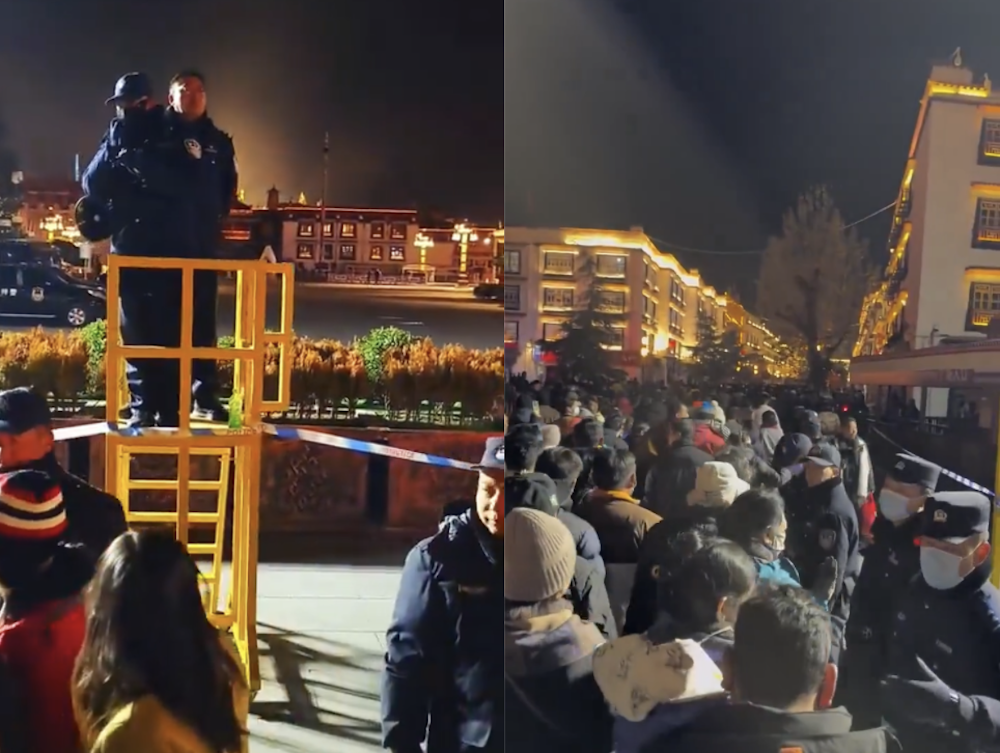
DHARAMSHALA, Dec. 16: Chinese authorities have reportedly deployed a heavy presence of police and paramilitary forces in Lhasa on Sunday during the annual Ganden Ngamchoe festival, a key religious observance commemorating the parinirvana of Je Tsongkhapa, the founder of the Gelug school of Tibetan Buddhism.
Ganden Ngamchoe, observed on the 25th day of the 10th month of the Tibetan lunar calendar, is traditionally marked by lighting butter lamps, circumambulating monasteries, and offering prayers at major religious sites, most notably the Jokhang Temple in Lhasa.
However, images and video footage shared by a Tibetan netizen on X (formerly Twitter) described an atmosphere of extreme tension surrounding the Jokhang Temple during this year’s observance. “It is supposed to be a sacred and peaceful day for religious beliefs. However, the Chinese Communist Party authorities have turned it into a day of extreme tension and paranoia,” the post read. According to the same account, the Jokhang Temple was surrounded by military and police forces arranged in “three levels,” highlighting what the netizen described as the authorities’ growing reliance on coercive measures to suppress religious expression under the pretext of maintaining stability.
According to Tibetan sources and past reporting by outlets such as Radio Free Asia (RFA), the security deployment during Ganden Ngamchoe in Lhasa follows a familiar pattern that has been repeated over several years. Armed and unarmed police, members of the People’s Armed Police (PAP), and other paramilitary units are stationed around key religious sites, including the Jokhang Temple and areas surrounding the Potala Palace.
Sources have reported that access points leading to these sites are tightly controlled, with multiple layers of checkpoints set up along major roads and narrow streets. At these checkpoints, police routinely check identity cards, question individuals about their purpose, and restrict entry once a certain number of people have gathered. In some areas, temporary inspection booths are erected, while patrols move continuously through surrounding neighbourhoods.
One of the primary objectives of the heavy security presence, according to analysts and rights observers, is to prevent large-scale religious gatherings. Tibetan festivals have historically been moments of collective religious expression and cultural visibility, something Chinese authorities have long viewed with suspicion.
During Ganden Ngamchoe, police are reported to actively discourage Tibetans from congregating in large numbers. Devotees attempting to light butter lamps or offer prayers in groups are often told to move along quickly or disperse. In some cases, access to monasteries is temporarily limited, with entry allowed only in small numbers or during tightly controlled time windows.
While officials claim such measures are necessary for crowd control and public safety, observers argue that the restrictions extend far beyond normal security concerns and are designed to minimize the public visibility of Tibetan religious devotion. Observers also note that the security deployment during Ganden Ngamchoe is not an isolated phenomenon but part of a broader Chinese policy aimed at exerting tight control over Tibet’s religious institutions and cultural identity. Similar measures are routinely reported during other major religious dates, anniversaries related to Tibetan history, and politically sensitive periods.

