

Tenzin Nyidon
DHARAMSHALA, Sept. 30: A bipartisan US congressional delegation that met with Tibetan leader His Holiness the Dalai Lama in Dharamshala on Wednesday reaffirmed Washington’s support for the Tibetan people, stressing that the recent meeting between US President Donald Trump and Chinese President Xi Jinping does not alter the US position on China’s treatment of Tibetans and other communities.
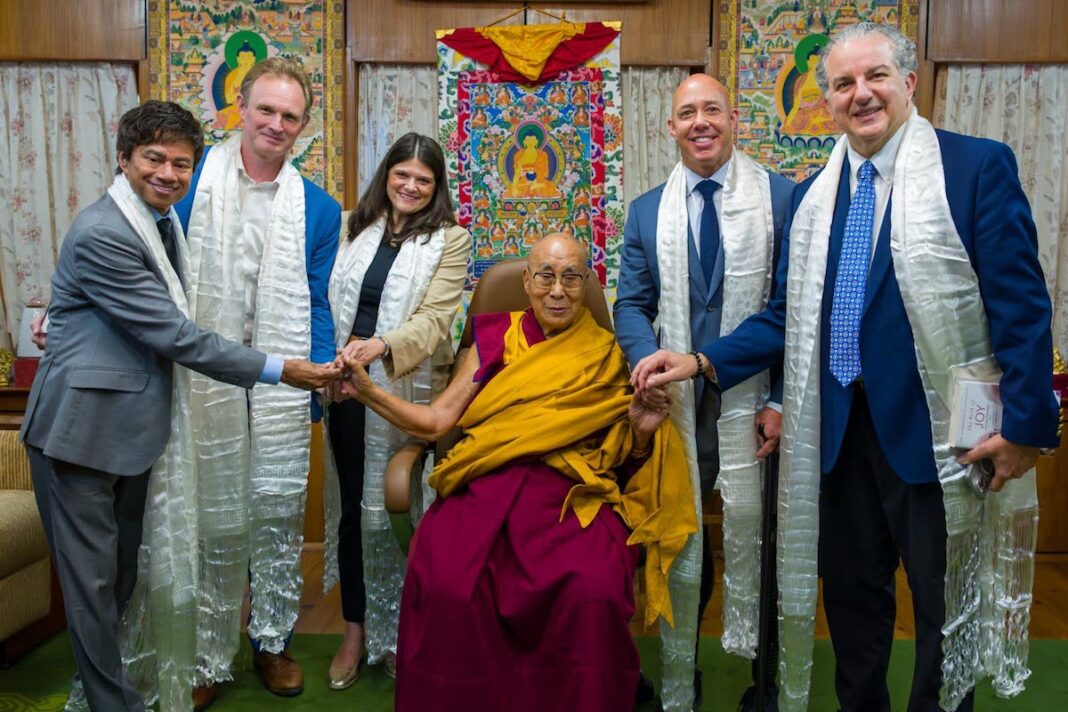
The delegation comprising Congressmen Brian Mast, James Gallagher, Jimmy Patronis, Shri Thanedar, and Haley Stevens met with the exile Tibetan spiritual leader during their visit to Dharamshala.
Speaking to media representatives after the audience, Congressman Brian Mast described his meeting with His Holiness as an experience he would “never forget,” saying the delegation held an extensive conversation with the Tibetan spiritual leader on a range of issues, including China, freedom in Tibet, and His Holiness’s advocacy for freedom around the world.
Phayul asked whether President Xi Jinping’s recent visit to Washington DC and his meeting with President Trump could have implications for the US approach to Tibet and Tibetan issues. Mast said His Holiness believes that dialogue between world leaders is important.
Mast said the meeting between the two leaders, however, should not be interpreted as diminishing US opposition to repression in China. “It doesn’t take away in any way from believing that China should not be repressing its people, should not be repressing the Tibetan people or the Uyghur people,” he said, adding that countries should instead work towards supporting freedom.
When asked by a media representative how he viewed the recent Trump-Xi meeting in relation to ties between the CTA and the United States, Mast said he saw it having a “positive” effect. “I see it affecting it positively. Every time that world leaders get together, there is a positive outcome in part in that there has been communication,” he said.
Mast acknowledged that such meetings do not necessarily produce an immediate or tangible outcome, but argued that communication allows governments to better understand one another. “It doesn’t always mean that there is an immediate, positive, tangible thing that you are taking away. But every time that we speak, we understand each other more,” he said.
When pressed whether the United States considers China a friend, Mast said Washington has a relationship with Beijing as two of the world’s largest powers, but pointed to significant areas of disagreement. “We have a relationship with China as two of the world’s largest superpowers,” he said.
“But China does not conduct friendly activities to the United States of America,” Mast said, citing what he described as intellectual property theft, espionage, and differences over fundamental rights and freedoms. “There are very big differences. And I think we can easily focus more on the acts that are counter to friendship than the acts that are synonymous with friendship,” he added.
Phayul asked the delegation about its outlook on the recently introduced Assuring the Future of Tibet Act of 2026 (AFTA), which seeks to strengthen US recognition of and engagement with the CTA in the post-Dalai Lama era.
Mast said he remains “very hopeful” about the legislation, pointing to bipartisan support for measures aimed at supporting Tibetans. “We’re always hopeful that we’ll do more and be able to pass more to support the people of Tibet. This is a bipartisan hope, constantly,” he said.
Phayul also asked whether the Chinese government had communicated any specific response to Washington following the passage of the Resolve Tibet Act, particularly in relation to the US call for Beijing to resume direct and substantive dialogue with His Holiness the Dalai Lama, his representatives or democratically elected Tibetan leaders without preconditions, the delegation said it had not seen an immediate or specific response from Beijing concerning the legislation.
Mast said, however, that the delegation’s presence in Dharamshala and its engagement with the exile Tibetan community and media could itself provoke a reaction from the Chinese government.
“I have seen no response from the Chinese government specifically,” Mast said. He added that a response could emerge at a broader level simply from the delegation’s decision to meet with His Holiness and visit Dharamshala.
“Because just the presence, being here with His Holiness, is something that they despise,” he said, adding that he believed the Chinese government would continue efforts to suppress the Tibetan people. “So yes, does it have an effect? Is there a response? Yes. Do we see it immediately? No, we do not,” Mast said.

