

Tenzin Nyidon
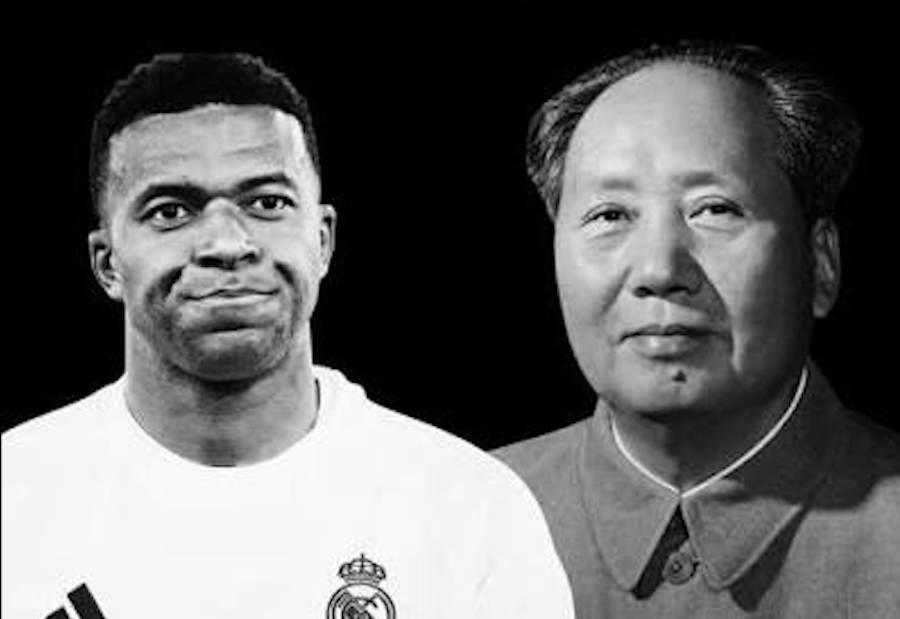
DHARAMSHALA, Oct. 27: French football star Kylian Mbappé has lost endorsement deals with at least three Chinese companies after remarks that appeared to refer to former Chinese leader Mao Zedong as a “dictator” sparked widespread backlash, prompting the Real Madrid forward to apologise publicly.
Beverage maker Dongpeng, dairy giant Mengniu and cheese producer Shanghai Milkground announced on Tuesday that they were terminating their partnerships with the 27-year-old France captain, citing opposition to words or actions that hurt the feelings of the Chinese people.
The controversy erupted after a video circulated online showing Mbappé discussing his favourite internet meme featuring himself. In the clip, he reportedly described an image of his face superimposed on the body of “some guy — I think he’s a Chinese dictator”, an apparent reference to Mao, the founding leader of the People’s Republic of China (PRC).

Following the uproar, Mbappé acknowledged that his remark was ill-judged and apologised to those offended by his words. “My comment was ill-judged, and I now understand that it hurt many people in China and in Chinese communities around the world,” he said in a statement posted on social media platform X (formerly Twitter).
“I have deep respect for the Chinese people and their history, and I am sincerely sorry,” he added, stressing that causing offence had not been his intention.
For Tibetans, the controversy surrounding Mao Zedong carries a historical significance that extends far beyond the sensitivities surrounding criticism of China’s founding leader. Mao’s rule is associated with a devastating period of repression in occupied Tibet, during which Buddhist religious institutions, sacred scriptures and cultural traditions suffered widespread destruction.
During the Cultural Revolution, launched in 1966 and lasting until Mao’s death in 1976, Red Guards and revolutionary authorities targeted monasteries, Buddhist statues, religious texts, and other symbols of Tibetan identity. The Jokhang Temple in Lhasa, one of Tibetan Buddhism’s holiest sites, was ransacked, while thousands of monasteries and religious institutions across Tibet were destroyed or left in ruins. Religious practices were suppressed, and monks and nuns faced persecution, imprisonment, and pressure to abandon monastic life.
The scale of the destruction had already alarmed the 10th Panchen Lama, one of the most senior figures in Tibetan Buddhism, who submitted his landmark 70,000-character petition to Chinese Premier Zhou Enlai in 1962. The petition documented the devastating effects of Chinese Communist policies in occupied Tibet, reporting that only around 70 of more than 2,500 monasteries remained and that the monastic population had fallen by approximately 93 per cent. These figures indicate that the systematic dismantling of Tibetan religious institutions had begun well before the Cultural Revolution.
The fallout has extended beyond commercial endorsements, with Chinese state television reportedly halting broadcasts of Spanish LaLiga matches and events involving Mbappé. Advertisements featuring the footballer have also been removed, according to Chinese state-backed media.
LaLiga president Javier Tebas separately apologised for the alleged remarks, expressing regret over the offence caused in China and saying the league was working with its Chinese partners to resolve the situation. “A relationship built over so many years cannot be damaged by a single episode,” Tebas said.
The incident has also fuelled a wave of criticism on Weibo, China’s widely used social media platform, where several hashtags calling for a boycott of Mbappé and announcing the termination of sponsorship agreements gained traction.
China’s Foreign Ministry spokesperson Guo Jiakun, responding to a question about the controversy, said that words and actions hurting the feelings of the Chinese people would naturally face opposition from across Chinese society.

