

Tenzin Nyidon
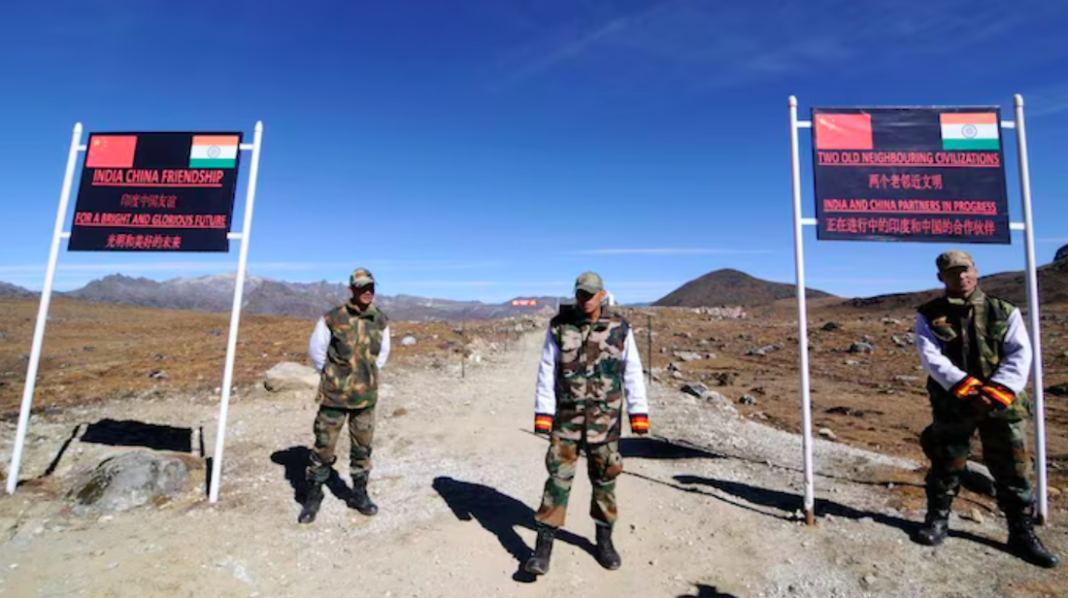
DHARAMSHALA, Oct. 26: India on Friday said the situation along the Line of Actual Control (LAC) is periodically disturbed when Chinese forces deviate from established patrolling patterns, following an announcement by the Indo-Tibetan Border Police (ITBP) chief that face-offs between Indian and Chinese troops were continuing at multiple locations along the Arunachal Pradesh frontier.
Responding to questions about the reported confrontations, Ministry of External Affairs spokesperson Randhir Jaiswal said both countries continued to use established diplomatic and military mechanisms to address outstanding border issues and prevent misunderstandings or miscalculations along the LAC.
“As we have noted in the past, the situation in the India-China border areas gets disturbed from time to time when Chinese forces diverge from established patrolling patterns,” Jaiswal said at a media briefing on October 23, referring questions about the specifics of the incidents to the Ministry of Defence. He added that the two sides had agreed to discuss ways to improve their understanding of the LAC in appropriate areas to strengthen border management, stressing that maintaining peace and tranquillity along the frontier remained essential to the overall development of bilateral relations.
Jaiswal’s remarks followed a public acknowledgement by ITBP Director General Shatrujeet Singh Kapur a day earlier that confrontations with Chinese troops had occurred at several locations in Arunachal Pradesh and were continuing.
Speaking at the ITBP’s annual Himveer Samman ceremony in Alwar, Rajasthan, on October 22, Kapur said the force’s newly raised Shaurya commando teams had played an exemplary role during the ongoing face-offs. “In the past few days, a situation arose where face-offs occurred at several locations in Arunachal Pradesh and this still continues,” he was quoted as saying. Kapur did not identify the specific locations involved or provide further operational details about the encounters.
The ITBP chief’s remarks have brought renewed attention to reports of a prolonged stand-off near Asaphila, close to Taksing in Arunachal Pradesh’s Upper Subansiri district, where tensions were reportedly building from late July.
According to reports citing government sources, Indian and Chinese troops initially encountered each other near Maja during routine patrolling. The two sides reportedly withdrew following a brief confrontation, but Chinese People’s Liberation Army (PLA) personnel subsequently returned in greater numbers and pitched tents on higher ground near the Maja company operating base.
The reported encampment was said to be approximately six to seven kilometres from the line India perceives as the LAC. Indian forces have reportedly strengthened their deployment in the area. However, the precise circumstances of the reported deployment and its relationship to the multiple face-offs referenced by Kapur have not been established publicly. Neither his remarks nor Jaiswal’s response provided a detailed account of the individual incidents.
The latest face-offs highlight the persistent challenges of managing a frontier where India and China maintain differing perceptions of the LAC and have yet to resolve their broader boundary dispute.
Arunachal Pradesh remains a particularly sensitive sector. Beijing claims the Indian-administered state, referring to it as “Zangnan”, or “South Tibet”, while New Delhi maintains that Arunachal Pradesh is an integral part of India and rejects China’s territorial claims. Differences over the alignment of the LAC have repeatedly brought patrols from the two countries into close proximity, sometimes triggering confrontations even as diplomatic and military channels remain active.
The latest statements from New Delhi indicate that both sides continue to rely on established mechanisms to manage tensions. However, the ITBP chief’s confirmation of continuing face-offs, alongside reports of a stand-off near Taksing, highlights the fragility of border stability in the eastern sector.

