

Tenzin Nyidon
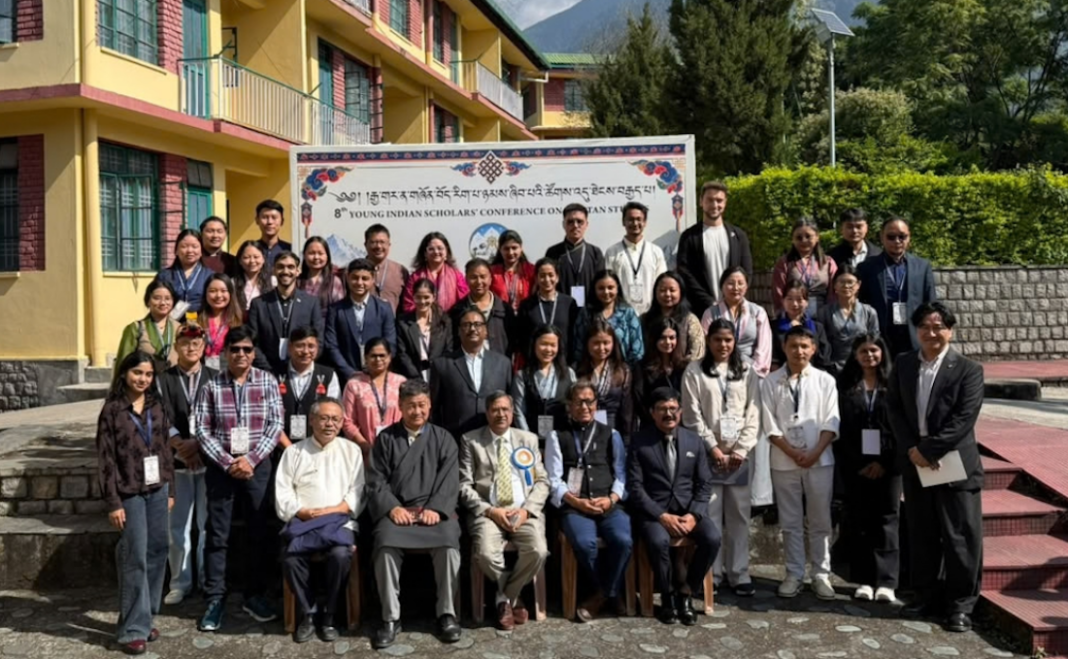
DHARAMSHALA, Oct. 8: The 8th Young Indian Scholars’ Conference on Tibetan Studies commenced Thursday at the Administrative Training and Welfare Society (ATWS) in Dharamshala, bringing together 25 researchers from across India for a three-day conference.
Organised by the Central Tibetan Administration’s (CTA) official think tank, Tibet Policy Institute (TPI), the conference is being held from October 8 to 10, 2026. Now in its eighth edition, the annual gathering gives emerging Indian scholars a platform to present original research and engage with fellow researchers working on Tibet, the Himalayas, and related fields.
Welcoming participants, TPI director and CTA spokesperson Tenzin Lekshay emphasised the importance of strengthening Tibetan Studies among Indian scholars, stating that the field is significant not only for Tibetans but for India itself. “Many times they get confused. Therefore, it is very important for the young Indians to educate themselves about Tibet,” Lekshay said, stressing that the conference was not organised merely “for the sake of Tibetans” but to develop Indian scholarship on Tibet “for the sake of India” and “for India’s interest.”
He noted that despite the longstanding historical relationship between India and Tibet, many Indians who sympathise with Tibet may lack a deeper understanding of Tibet’s geography, history and relationship with India. “It is very important for India to understand Tibet,” he said, urging young scholars to develop their expertise so they can eventually answer questions within India about the country’s historical and contemporary relationship with Tibet.
The conference was formally inaugurated by Prof. Sat Prakash Bansal, Vice Chancellor of the Central University of Himachal Pradesh (CUHP), who highlighted the importance of strengthening academic research on Tibet, the Himalayas and India-Tibet relations.
Prof. Bansal said the conference’s themes—including strategy and security, historical relations, Buddhism and technology, and cultural heritage—reflect issues that extend beyond academia and are closely linked to India’s history, national security and future.
Describing Dharamshala and the Himalayas as a “living lab” for research, he emphasised the region’s historical role as a bridge for the exchange of knowledge, culture, philosophy and traditions between India and Tibet. He called for renewed academic engagement with this shared heritage while encouraging universities to connect traditional knowledge with emerging fields such as artificial intelligence, digital humanities, climate science and environmental studies.
He also urged young scholars to move beyond viewing Tibet solely through geopolitics, Buddhism solely through religion, and the Himalayas solely through geography. Instead, he called for interdisciplinary research linking history with contemporary politics, culture with technology, Buddhism with peace studies, and traditional knowledge with sustainability.
Calling on universities to play a greater role in contemporary Tibetan and Himalayan scholarship, Bansal said academic institutions should not merely preserve knowledge but “interrogate it, reinterpret it and make it relevant to contemporary society.”
He pointed to the potential for interdisciplinary research connecting traditional knowledge with artificial intelligence, digital humanities, climate science, environmental studies and emerging technologies. “We cannot survive without adopting new technology,” he said, while stressing the need to remain connected with traditional knowledge alongside technological development.
He highlighted the Buddhist intellectual tradition’s emphasis on inquiry, debate, logic and examination, and referred to the Dalai Lama’s advocacy of examining Buddhist teachings through reason and investigation rather than accepting them blindly. He also pointed to the potential convergence between Buddhist analytical traditions and scientific inquiry.
He said the Central University of Himachal Pradesh plans to collaborate with the Tibet Policy Institute and other institutions in the region on joint research projects, archives, fellowships, language programmes and digital repositories.
He also proposed greater collaboration between universities and institutions through joint research projects, archives, fellowships, language programmes and digital repositories, with the broader aim of making the Himalayas a centre for interdisciplinary research and peaceful knowledge cooperation. He said such initiatives would strengthen academic cooperation and help establish the Himalayas as a centre for interdisciplinary research and peaceful knowledge exchange.

