

Tenzin Nyidon
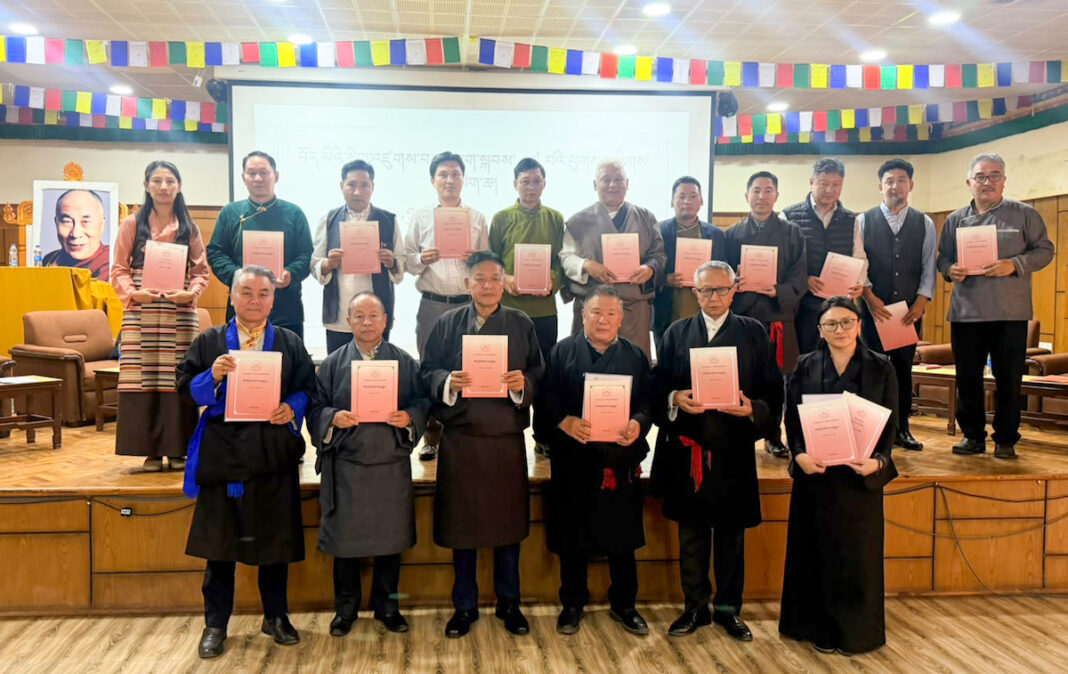
DHARAMSHALA, Oct. 1: The exile Tibetan government, officially known as the Central Tibetan Administration (CTA), under the 17th Cabinet led by President Penpa Tsering, on Wednesday unveiled its revised five-year “Vision Paper: Securing Tibet’s Future.” The CTA President outlined its priorities for the 2026–31 term across three broad areas: advancing the just cause of Tibet, safeguarding the welfare and sustainability of Tibetans in exile, and strengthening the CTA’s institutional capacity.
Released three years after the 16th Kashag (Cabinet) introduced its first Vision Paper under the guiding principles of Equitable Justice, Cooperative Effort and Moving Forward, the revised document retains the Middle Way Policy as the CTA’s existing political direction, seeking to resolve the Sino-Tibet conflict through non-violence and dialogue.
At the same time, the 17th Cabinet introduces several new or more specifically defined priorities, including greater engagement with the Chinese public, a campaign for international recognition of Tibet’s historical status, preparation against possible Chinese interference in the Dalai Lama’s reincarnation, the relocation of 1,855 households, phased consolidation of Tibetan schools, and the introduction of artificial intelligence and data-management systems within the CTA.
Retaining the Middle Way Policy, the paper states that the current Chinese government’s policies offer no indication of an opening for a mutually agreed solution. Nevertheless, the Cabinet says it will continue pursuing a lasting settlement through non-violence and dialogue while adapting its strategy to changes in international politics and developments in China and Tibet.
The 17th Cabinet is changing the machinery and scope of advocacy surrounding that policy. The revised Vision Paper proposes expanding the CTA’s engagement beyond governments and traditional international advocacy networks to include the Chinese public. The Cabinet says it will build on its previous engagement with overseas Chinese communities and strengthen joint activities with Mongols, Uyghurs, Manchus, Hongkongers, and Taiwanese. It also proposes developing approaches to inform Chinese people about Tibet and what it describes as Chinese government repression.
The revised paper gives specific attention to what it describes as Chinese government attempts to weaken the Tibetan movement through infiltration, deception, and efforts to create divisions within the exile community. The Cabinet identifies regional, sectarian, and political divisions as areas of concern and says the CTA, particularly its Task Force on Political Crises, will respond to such activities.
The Cabinet also proposes strengthening the Voluntary Tibet Advocacy Group (V-TAG) by providing members with advocacy materials and training and by expanding participation through V-TAG+, including greater involvement from non-Tibetans. It also seeks stronger cooperation among Tibet advocacy groups, parliamentary support groups, Tibetan associations, umbrella organisations, and NGOs operating within the jurisdictions of the Offices of Tibet.
The 17th Cabinet retains the previous administration’s emphasis on strengthening compact Tibetan settlements to sustain the community in exile. One of the most concrete commitments in the new Vision Paper is relocating 1,855 households registered with the CTA’s Department of Home. The paper says the relocation has already begun and is being actively followed up, with housing for Tibetans without homes or land intended to strengthen compact Tibetan communities.
The 17th Cabinet proposes the progressive consolidation of Tibetan schools in India, based on birth data, current student enrolment and the circumstances and needs of individual schools. The Department of Education is expected to consult educational bodies and develop a jointly agreed plan for phased consolidation. School integration was already identified by the 16th Cabinet as necessary in response to declining student numbers. The new Vision Paper, however, places greater emphasis on moving toward an organised, data-based, and phased consolidation process.
The preservation of Tibetan language remains a longstanding priority, but the 17th Cabinet expands the scope of that policy. The CTA says its offices and associated bodies will prioritise Tibetan in correspondence, announcements and meetings. It also proposes support for Tibetan-language software for technological and artificial intelligence systems, as well as Tibetan films, animations and short-form social media content. The language policy is therefore no longer limited to schools and traditional cultural preservation; it explicitly includes digital technology and AI.
On strengthening the capacity of the CTA, the Cabinet proposes establishing an Institutional Development Index–Data Management (IDI-DM) system to manage institutional databases and standalone software applications. It also proposes a dedicated Statistics Section serving the CTA.
The Vision Paper proposes continuing the development of several AI-assisted administrative systems, including: rules database; personnel database; personal assistant; project tracking portal; and budget database. The CTA also proposes progressively sharing these systems across departments as they become operational.
The Cabinet says civil servants will receive stronger practical training in artificial intelligence and information technology, alongside specialised training from experts and experience-sharing among officials.
The Cabinet says it will strengthen data collection and analysis, improve monitoring of activities and evaluate results more systematically. The stated aim is to improve target achievement and ensure that programmes approved by the administration are properly implemented and followed up.

