

Tenzin Nyidon
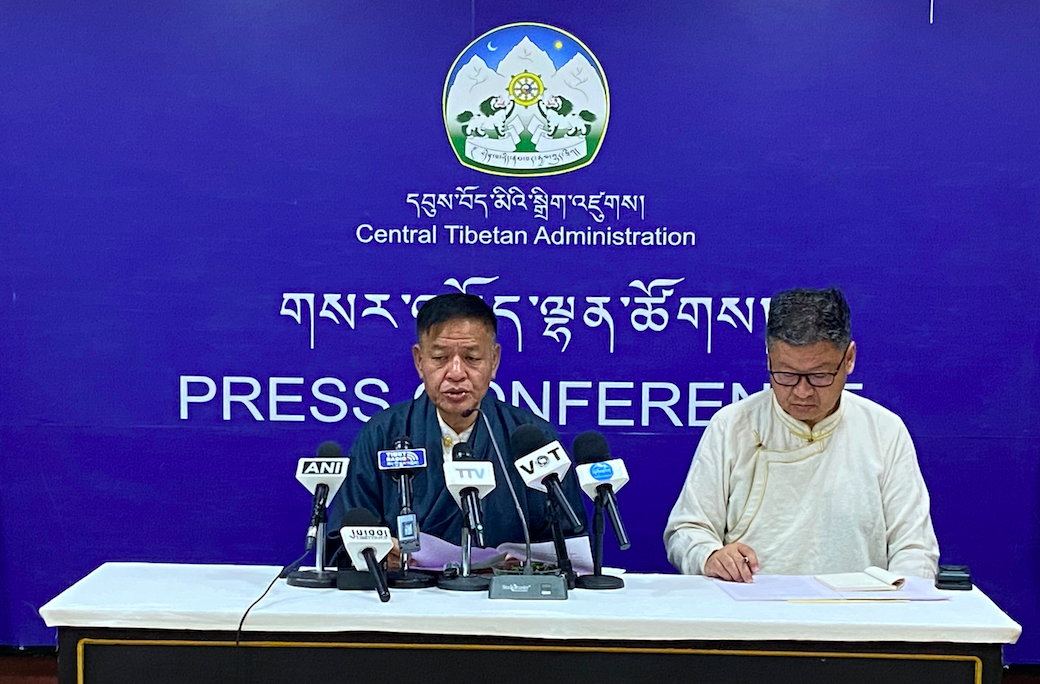
DHARAMSHALA, Sept. 23: The Central Tibetan Administration (CTA) President Penpa Tsering on Wednesday formally launched the observance of “Tibetan National Identity Preservation Week,” an initiative aimed at reinforcing Tibetan language, culture, and national identity in response to what the exile administration describes as China’s state-driven assimilation policies in occupied Tibet.
As the first public initiative marking this year’s “Tibetan National Identity Preservation Week,” the Tibet Museum under the CTA’s Department of Information and International Relations (DIR) organised a screening of the animated film Man of Peace at Maximus Mall in Lower Dharamshala, followed by an evening play at the Tibetan Institute of Performing Arts (TIPA) depicting the implications of China’s so-called “Ethnic Unity and Progress Law.”
The CTA President said the week-long observance will be held during the fourth week of September, following a resolution adopted during the 11th session of the 17th Tibetan Parliament-in-Exile designating the period as the “Tibetan National Identity Preservation Week.”
The initiative comes in response to China’s annual “Ethnic Unity and Progress Propaganda Week,” which, according to the CTA President, Chinese state institutions use to promote assimilation-oriented policies and campaigns centred on the dominance of the Chinese language and a unified national identity.
President Tsering also referred to amendments made by the Chinese government on 27 December 2025 to the country’s “Law on the National Commonly Used Language and Script.” According to the CTA, the revised provisions further institutionalise Mandarin as the principal language of instruction from preschool through higher education, as well as in government offices and public spaces. He said the annual propaganda campaign forms part of a broader effort by Chinese authorities to consolidate the use of Mandarin and promote what Beijing describes as “ethnic unity.”
Calling for collective participation in the observance, the CTA President urged Tibetans worldwide—including individuals, families, schools, community organisations and activists—as well as supporters of Tibet, to work under the guidance of Offices of Tibet representatives and Tibetan Settlement Officers.
He also called on Tibetan communities to stand in solidarity with Tibetans inside Tibet and implement the activities outlined in the public announcement issued by the Cabinet on 21 August 2026, alongside the newly launched “Principles and Guidelines for the Preservation of Tibetan Language.”
The comprehensive guidelines set out responsibilities for families, schools, Tibetan communities, and the CTA Department of Education, with measures ranging from making Tibetan the primary language of communication at home and strengthening Tibetan-medium education to establishing community language classes, immersion programmes and greater use of Tibetan in public spaces and social media. The guidelines also call for teacher training, scholarships, modern Tibetan-language educational resources and the development of Tibetan terminology for contemporary fields.
The policy further calls for greater integration of Tibetan into digital technologies, including machine translation, speech recognition, artificial intelligence and optical character recognition, while reaffirming Tibetan as the official language of the CTA. A three-to-five-member Tibetan Language Preservation Committee is also to be established to monitor implementation and publish an annual assessment of the policy.

