

Tenzin Nyidon
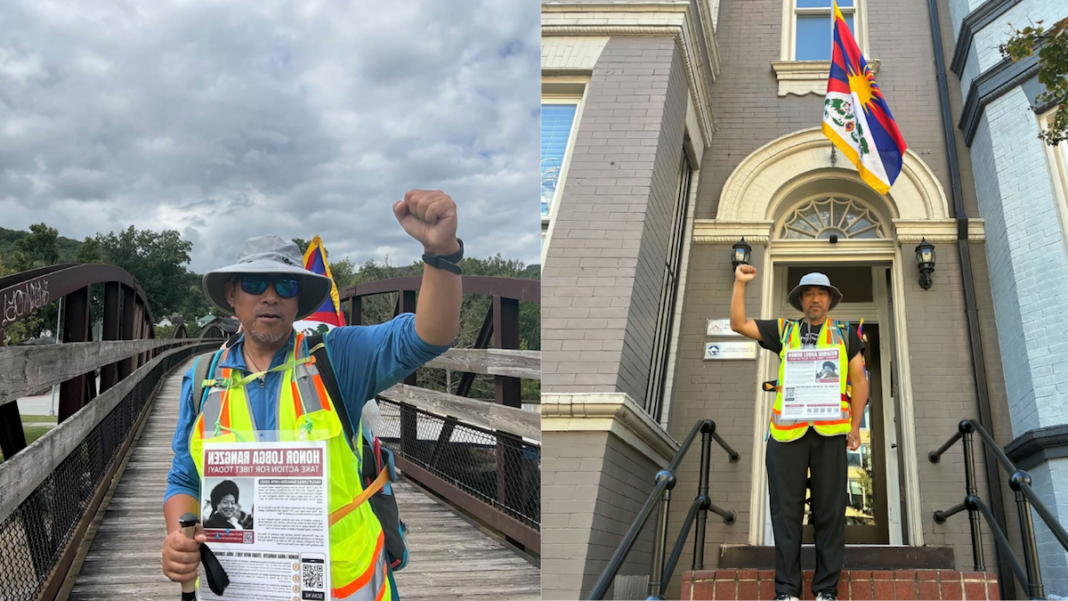
DHARAMSHALA, Oct. 6: Tibetan activist and lone marcher Sonam Dorjee has covered more than 1,000 kilometres on foot in 42 days as part of his ongoing “Freedom March” across the United States, a journey he says is dedicated to raising awareness about the Tibetan issue and in solidarity with Tibetans who have self-immolated for freedom.
Sonam began the march on August 24, 2026, from the Chinese Consulate in Chicago. Speaking to Phayul from Baltimore, he said he has walked through Indianapolis, Dayton, Columbus, Pittsburgh, parts of Maryland and Virginia, Washington D.C., and is currently in Baltimore.
“I have covered more than 1,000 to 1,100 kilometres,” Sonam said, adding that the entire journey from Chicago to New York is expected to cover at least 1,400 to 1,500 kilometres over approximately 55 days.
The final leg of the march will take him to New York, where he plans to conclude the journey on October 17 in front of the United Nations, at the site associated with the self-immolation of the late Tibetan independence activist Lobga Rangzen. He said the march is particularly dedicated to the late martyr, whom he described as the first Tibetan American to self-immolate on U.S. soil, as well as to more than 170 Tibetans who have self-immolated in occupied Tibet and elsewhere.
Beyond raising public awareness, he said the march has also served as an advocacy campaign, allowing him to meet American lawmakers and their staff and lobby for greater U.S. support for Tibet. During the 42-day journey, he said he has interacted with more than 1,000 individuals and groups. He said public responses have varied, with many Americans initially unfamiliar with the Tibetan issue but expressing sympathy and solidarity after learning about self-immolation in occupied Tibet.
Some members of the public have supported the march by sponsoring meals, providing accommodation or making donations, he said. Sonam said nine American restaurants or café owners provided him with food during the journey, while at least five Americans donated money towards his campaign.
A major component of Sonam’s march has been lobbying U.S. lawmakers. He said he has met or sought to lobby with at least 10 members of Congress during the journey, including representatives or their offices in Indianapolis, Dayton, Columbus, Pittsburgh, Frederick, Rockville and Washington, D.C.
He said he has urged lawmakers to support two Tibet-related bills already introduced in the U.S. House of Representatives, while also asking them to pressure Beijing over its policies toward Tibet, including the so-called “Ethnic Unity and Progress Law.”
One of his most significant lobbying experiences came in Columbus, where he visited the office of U.S. Representative Joyce Beatty. According to him, the delegation met with the district director, district executive director and several staff members.
“They listened to us very nicely, and they inquired about what is inside the bill and how we can support the Tibetan cause,” he said, describing the meeting as one of the most notable experiences of the journey. He said he also received particularly encouraging responses from meetings in Columbus and Pittsburgh.
Sonam’s journey is now entering its final phase. From Baltimore, he expects to travel next to Wilmington, Delaware, where he plans to meet with members of Congress, followed by Philadelphia. He then plans to continue to New Jersey before making his way to New York.
The march will culminate on October 17 outside the United Nations, marking the end of what he describes as a 55-day walk for freedom. By the time he reaches New York, Sonam expects to have walked more than 1,400 kilometres, with the possibility of reaching approximately 1,500 kilometres depending on the final route.
“This whole journey is dedicated, especially to the self-immolation of the late martyr Lobga Rangzen,” he said. “My 55 days of walking from Chicago to New York will be dedicated to Pawo Lobga Rangzen.”

