

Tenzin Nyidon
DHARAMSHALA, Nov. 27: The President of the Tibetan government-in-exile, officially known as the Central Tibetan Administration (CTA), Penpa Tsering, warned that China’s policies in occupied Tibet and its treatment of Tibetans and Uyghurs could serve as a template for what the rest of the world may face as Beijing expands its global influence, urging governments to reassess their engagement with China.
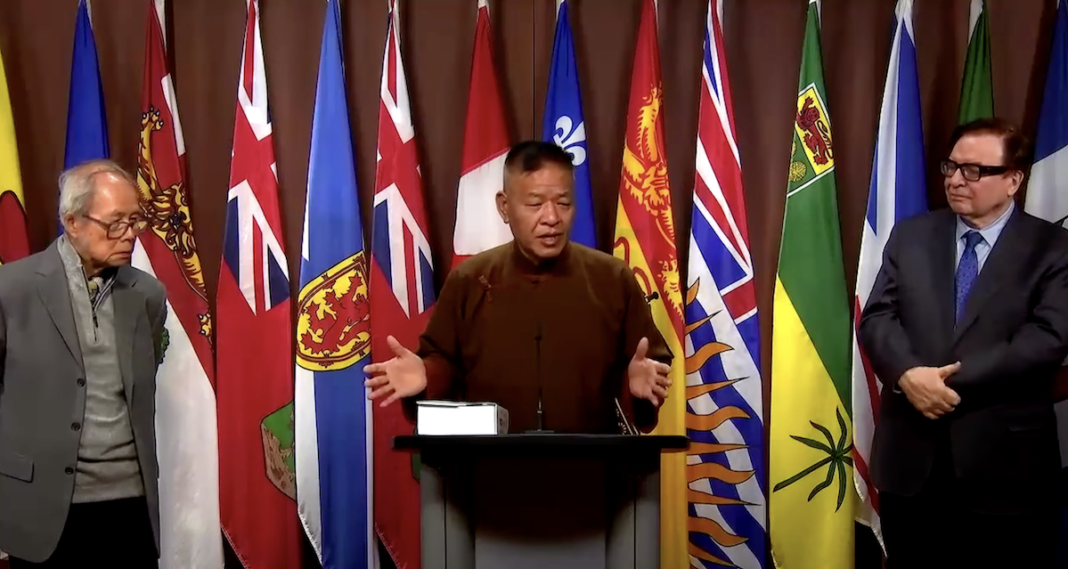
“What China is trying to do to Tibet and what China is doing within China and to Tibetans and Uyghurs in Mongolia is a template for what is going to come for the larger, wider world,” the CTA President said on Wednesday during a media briefing organised by Optimum Publishing International at Parliament Hill in Ottawa, Canada. He is currently on an official visit to Canada, engaging with Canadian parliamentarians and other officials to raise concerns over China’s policies in occupied Tibet and seek greater international support for the Tibetan cause.
He urged governments to examine China’s Belt and Road Initiative (BRI), alongside its Global Civilisation Initiative, Global Security Initiative, Global Development Initiative and proposed global governance system, cautioning that Western countries had played a role in strengthening China’s economic and political position.
“Because as China grows, which the Western developed countries are making it grow, then they will bite back at you,” he said, questioning why countries continued to empower Beijing despite what he described as the consequences of its growing influence.
“Knowing that the dragon is biting back at you, if you still keep feeding the dragon, then we’ll have to rethink as to who should be blamed for,” he added.
The Tibetan political leader also devoted a significant part of his address to the issue of the reincarnation of the 14th Dalai Lama, accusing the Chinese government of seeking to control the succession process to extend its political authority over Tibet and the Tibetan people.
He stated that Beijing is waiting for the death of the 14th Dalai Lama to assert its claim over the selection of his successor, believing that controlling the institution of the Dalai Lama would enable it to exercise greater control over Tibet and its people. He emphasised that reincarnation is a centuries-old spiritual tradition in Tibetan Buddhism, which he said has been practised for approximately 900 years and is rooted in the Buddhist belief in rebirth.
He specifically criticised China’s 2007 regulation, commonly known as Order No. 5 and officially titled the Measures on the Management of the Reincarnation of Living Buddhas in Tibetan Buddhism, which establishes state procedures for the recognition of reincarnated Tibetan Buddhist spiritual leaders and requires government approval.
He outlined three positions that he said the Chinese government maintains regarding the Dalai Lama’s reincarnation: that the successor must be found within Chinese territory, that the traditional Golden Urn procedure must be followed, and that Beijing must have the final authority to approve the recognition. Criticising China’s position that the next Dalai Lama must be born within its borders, the CTA President cited the Dalai Lama’s own response: “I will be born in a free world.”
He also challenged the historical basis of Beijing’s insistence on the Golden Urn, a Qing dynasty-era instrument that Chinese authorities invoke to justify their claimed role in the recognition of Tibetan reincarnated spiritual leaders. Referring to Professor Hon-Shiang Lau’s book, “Tibet Was Never Part of China Since Antiquity,” which also examines the Golden Urn claims, the CTA President said there were no authoritative Chinese government documents or corresponding Tibetan records establishing the narrative presented by Beijing. He also questioned its historical application, noting that the procedure was not used in the recognition of either the 13th or 14th Dalai Lama.
Responding to China’s insistence on having the final say in the recognition process, he recalled the Dalai Lama’s humorous suggestion that Beijing should first study Buddhism and accept the concept of life after death if it was genuinely serious about reincarnation. He also recalled how Dalai Lama’s humorous remark that if Beijing was serious about reincarnation, it should first search for the reincarnations of former Chinese leaders Mao Zedong, Deng Xiaoping and Jiang Zemin before turning its attention to the Dalai Lamas.
The Ottawa media engagement featured CTA President Penpa Tsering alongside Dean Baxendale, President and Publisher of Optimum Publishing International, China analyst Dr Charles Burton, and Professor Hon-Shiang Lau. The discussion addressed Canada’s commitment to addressing forced labour, cultural repression and the intimidation of Tibetan Canadians on Canadian soil; Beijing’s new “Ethnic Unity and Progress Law,” designed to eliminate Tibetan national identity and silence its defenders, even beyond China’s borders; and China’s use of its own imperial and government records to challenge the historical justification upon which Beijing bases its colonial occupation of Tibet.

