

Tenzin Nyidon
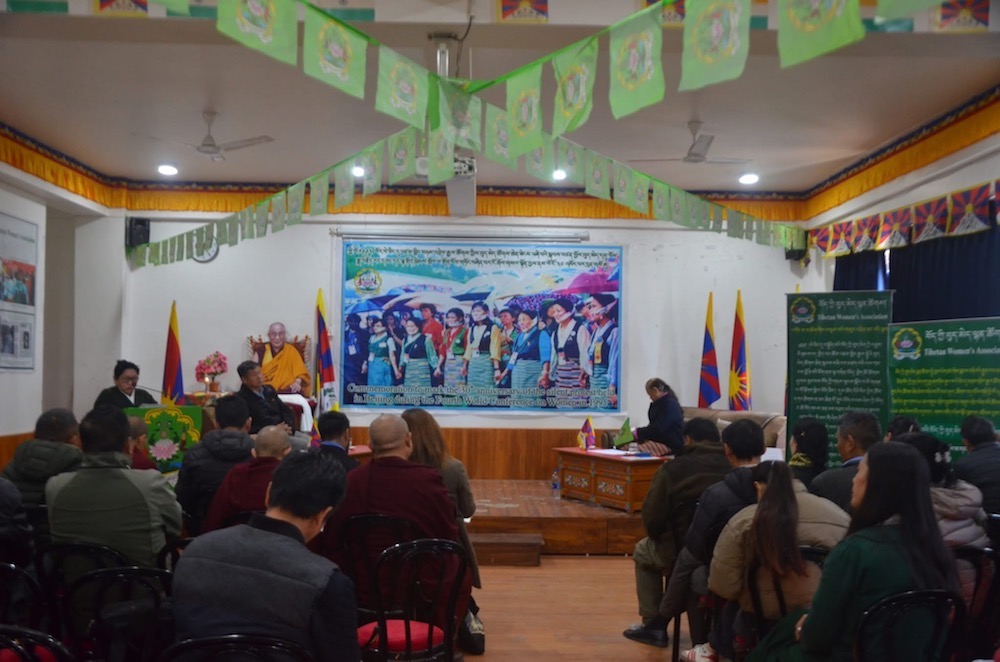
DHARAMSHALA, Dec. 5: The Tibetan Women’s Association (TWA) on Friday commemorated the 30th anniversary of the historic ‘Silent Protest’ held during the United Nations Fourth World Conference on Women in Beijing in September 1995. The event, observed at the Tibetan Settlement Hall in Dharamshala, honoured a pivotal moment in the Tibetan freedom struggle, an act remembered as the first protest by Tibetan exiles against Chinese rule on Chinese soil.
During the original protest in 1995, nine Tibetan exile women, Gyalthong Tsering Dolma, Kherol Seldup, Tenzin Dolker Jinpa, Chime Dhonden, Youdon Dhonden, Phuntsok Dolma, Kalsang Wangmo, Dorje Dolma Kherol, and Tsomo Namgyal, stood in silent defiance under the falling rain, scarves tied over their mouths to symbolize China’s systematic silencing of Tibetan women’s voices in Tibet. Notably, these nine were the only Tibetan exiles granted visas to attend the conference in Beijing.

Special guest Ngawang Lhamo, who served as TWA’s General Secretary during that period and played a central organising role, despite being unable to attend the conference herself, recounted the immense challenges of the time. She explained that securing seats for Tibetan women at the Beijing conference was the result of years of persistent negotiations and strategic engagement on international platforms. In the lead-up to the conference, she noted, TWA vigorously advocated not only for the rights of Tibetan women but also for broader women’s rights and human rights conditions in China, joining global campaigns that questioned the legitimacy of hosting a UN conference in a country with such a record.
Additionally, during today’s commemoration, a letter from Eva Harzer, who served as a guide and mentor to the exile Tibetan women delegates for their security during the 1995 conference, was presented. In her message, Harzer described the extensive efforts undertaken to ensure that Tibetan women in exile could participate meaningfully in the UN Women’s Conference. “To this end,” she wrote, “I reached out to numerous women’s and human rights organisations to secure Tibetan representation on panels addressing reproductive rights, colonisation, foreign occupation, and the struggles of Indigenous peoples.”
Harzer also recounted the intense surveillance and repression imposed by Chinese authorities during the conference. “We decided that each Tibetan delegate would be accompanied day and night by a Western woman delegate,” she noted. “We selected only Tibetans holding citizenship in another country to ensure diplomatic protection in the event of trouble.” She highlighted how these arrangements not only safeguarded the Tibetan delegates but also enabled international participants to understand more deeply the hardships Tibetan women face under Chinese rule. “Fortunately, many groups expressed their solidarity by stepping forward, including the International Lesbian Human Rights Commission,” she added. Harzer concluded by emphasising that the exchange of solidarity flowed both ways as Tibetan women, too, stood with women of other nationalities who were confronting parallel forms of discrimination and oppression.
Reed Brody, a human rights lawyer who accompanied the Tibetan women’s delegation, in a video message, said that the group had been under constant surveillance from the moment they arrived and throughout the conference. “From the very first day of the forum, the police were on us. They followed us, and they harassed us,” Brody said.
Brody, who personally witnessed the ‘Silent Protest,’ emphasized that despite the heavy restrictions and unrelenting surveillance imposed on the exile Tibetan women, their protest remained a profoundly symbolic act, an unambiguous refusal to be muted by the authoritarian regime.
The protest also drew international attention to the Tibetan cause, garnering coverage from major global news outlets, including The Washington Post, The New York Times, Women’s Feature Service, The Earth Times, Terra Viva, The Edge, Danish media, and broadcasters such as the BBC, CNN, Egyptian TV, among others.

