

Tenzin Nyidon
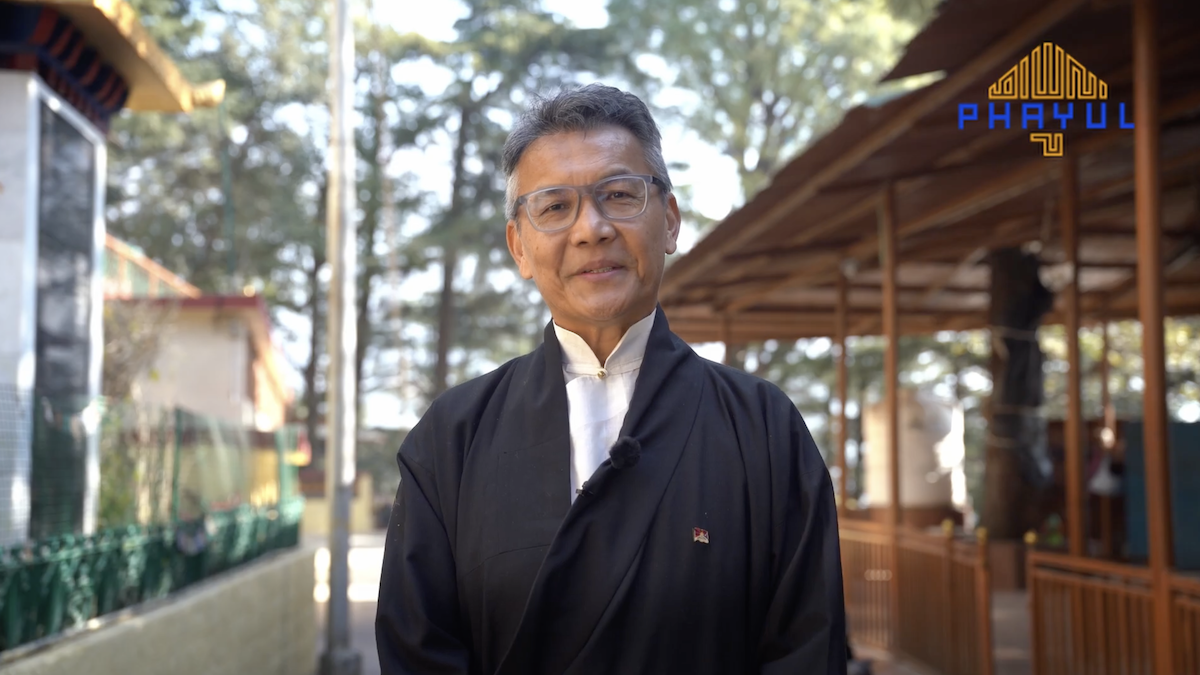
DHARAMSHALA, Nov. 21: Presidential candidate Kaydor Aukatsang has called for formal, mandatory debates among all candidates running in the 2026 presidential election, saying such public engagement is a “prerequisite for a healthy democracy” and a core responsibility for anyone seeking the highest office of the Central Tibetan Administration (CTA).
Speaking at Lhagyal Ri in Dharamshala during a press interaction shortly after announcing his candidacy on Wednesday, Kaydor emphasised that debates are essential for fostering transparency, enabling voters to make informed decisions, and strengthening the democratic culture in exile. His remarks come amid rising public concern following incumbent President Penpa Tsering’s earlier statement that he would not participate in campaign debates, interviews, or any form of public election-related discussions as he seeks a second term.
Responding to a question from Phayul regarding public apprehension over the incumbent’s not participating in debates, Kaydor said that while the election charter restricts formal campaigning by those holding office, it does not prohibit participation in public debates.
“He can participate in debate,” Kaydor noted, adding that incumbents naturally enjoy increased visibility through official travel and public engagements. “But the decision not to participate in the debate is really unfortunate. It damages our exile democracy.” He reiterated that debates allow candidates to present their vision, respond to public questions, and face scrutiny—elements he described as both a moral and a political responsibility.
“I support 100% the need and importance of debates. We need to have at least two, one in Tibetan and one in English. This is the responsibility of anyone running for Sikyong (President),” he said. “I hope the Election Commission (EC) will seriously look into it.” Kaydor also called for debates to be held during both the preliminary and final rounds, recalling that similar discussions took place during the 2021 race.
Reflecting on his previous run in the 2021 presidential election, in which he lost by a margin of 5,417 votes, Kaydor said he is entering the 2026 race with full confidence. “I’m 100% confident. I would not be putting myself through this challenging process if I wasn’t in this race to win,” he said, acknowledging the personal, financial, and mental demands of campaigning.
Kaydor suggested that his opponent’s multiple attempts in previous elections may have influenced the outcome in 2021. This time, he believes voters will be evaluating the incumbent’s record rather than giving “an opportunity” based on persistence. “People have seen him in office for five years. Whether you support him or are not happy with his performance, the record is there,” he said. “If people give me an opportunity, I’m very confident I can deliver on the commitments I plan to make.”
Kaydor’s campaign message places strong emphasis on unity, an area he believes has weakened within Tibetan exile politics in recent years. “Our community has become polarized and factionalized,” he said. “For us to be successful in our freedom struggle, we need unity and resources. Everything else should be beneath that.”
He stressed that the President must set the right example by prioritizing collective interests over individual prominence. “If people give me the opportunity, I will be a Sikyong for all Tibetans, not for one faction or the other,” he said. “Give less emphasis on the self and more on the collective.”
Kaydor’s strong advocacy for candidate debates sets the tone for what may become a focal issue in the lead-up to the 2026 presidential election. Whether the EC will organise formal debates and whether the incumbent will reconsider his stance remains to be seen. However, the call for open public discourse is expected to resonate widely among voters as the election season begins to take shape.


Whether Sikyong Tsering remains in power or jets off to Canada aftermath of the election doesn’t seem to matter much to him. He’s contributed his fair share to the cause and now deserves some quality time for himself. But if Kaydor wins the next election, I sincerely urge him to preserve the V-Tag (Voluntary Tibet Advocacy Group) initiative that Penpa Tsering introduced. I believe this initiative represents the collective voice of the people rather than individual interests.
The upcoming Sikyong contest is going to be interesting. The incumbent Sikyong has had one stint by winning the previous election. During that time, there was a sense of “sympathy for alleged injustice” by the former Sikyong after he was turfed out as the Representative of the Dalai Lama in Washington. He took the then Kashak to the court and won the case known as case 20. It was perceived as a vindication of the their belief in the “injustice” that they thought was visited upon him. As a result he rode on the sympathy wave generated by the dismissal. It must also be said that it was controversial and the judge who acquitted the Challenger of any wrong doing resigned that very evening! It is in this environment that the present incumbent came victorious over his challger Kador Akutsang. However, it’s been five years since that time and attitudes have changed owing to the performance of the present Sikyong. One of the most controversial issue right after the election was the issue of oath taking. Opinions were divided among the parliamentarians about the veracity of taking oath from Dawa Tsering who was appointed as the person to deliver the oath to the elected members. While some were happy to take from Dawa Tsering others were circumspect and not willing to do so. This was an issue that became log-jammed where the Dalai Lama was asked to intervene. The oath taking ceremony was conducted but the discord remained. Another issue that bedevilled the Tibetan community was the issue concerning religious representatives. A section of the incumbent supporters demanded the disqualification of the religious representatives saying such representatives were irrelevant in this day and age! They even organised themselves to go to Dharamsala to demand their resignation or expulsion. Such issues are unwarranted but his supporters were using the “public demand” as a pretext for their exclusion. This divided the community even further. Another issue was the inability of the present Sikyong to appoint seven Kalons as enshrined in the charter which his opponents assert has made the Kashag ineffective which caused dereliction of duty. The latest episode is the denial of an opportunity to meet the Dalai Lama to a person living in Europe who had been representing his community in the Czech Republic to offer long life puja to the Dalai Lama! He was denied audience with the Dalai Lama for his outspoken criticism of the Sikyong! These episodes during the last five years have dented the enthusiasm for Sikyong Penpa Tsering from a sizable section of the diaspora population. On top it is the fatigue of the present leader after five long years! Therefore, the new challenger obviously want to challenge him in front of the public for his performance and get some answers from the incumbent. It is only fair for the Sikyong to take up the challenge if he is a Democrat and wan to win fairly and squarely. Let the people know your manifesto for the future so the public can make their choice. Debate and discussion are indispensable in a democracy. The whole idea of democracy is to solve problems through understanding each others point of view without resorting to violence such as war. Differing views are integral part of democracy as English writer Evelyn Beatrice Hall said, “I disapprove of what you say, but I will defend to the death your right to say it”. The challenger Kaydor Akutsang has a much better opportunity than his previous attempt to win the Sikyong seat. The above mentioned episodes during the rein of present Sikyong has changed public opinion even though his die-hard supporters may not change. The strongest point Kaydor can make is the Tibet issue itself which has all but gone off the international radar during the incumbent’s watch. He can make this a central theme in his attempt to gain traction with the public as the Tibet issue is the most important goal of the Tibetan freedom movement. He seems likeable in nature and has the looks of a leader and is humble at the same time. As Napoleon Bonaparte is reputed to have said, “impossible is found in the fool’s dictionary”, Kaydor Akutsang may well be able to pull a surprise this time around!