

Tenzin Nyidon
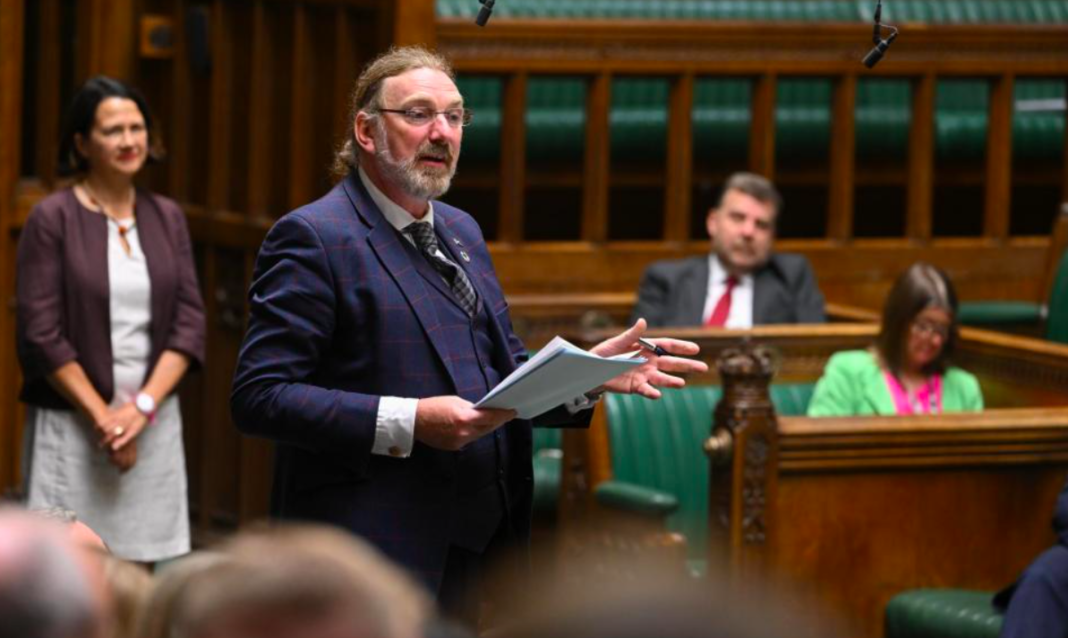
DHARAMSHALA, Jan. 30: Scottish National Party MP Chris Law, a long-time parliamentary advocate for Tibet, has categorically rejected China’s claim to authority over the succession of His Holiness Dalai Lama, stating that the Tibetan spiritual institution “cannot be politically appointed—certainly not by the Chinese Communist Party (CCP).”
Speaking in an interview with The Print, Law framed Beijing’s insistence on controlling the reincarnation process as a direct assault on Tibetan Buddhism itself, warning that any state-appointed successor would fundamentally undermine both the office of the Dalai Lama and the religious tradition it represents.
Law contextualised the succession debate within what he described as China’s systematic attempt to rewrite Tibetan history. He argued that Beijing has sought to portray Tibet as having always been part of China, a claim he said is contradicted by historical evidence.
“Tibet was always an independent, autonomous nation,” Law said, adding that Britain once maintained direct diplomatic relations with Tibet prior to China’s military invasion in 1949. In his view, Tibet should be regarded as an occupied territory following the permanent occupation that began in 1959, when the 14th Dalai Lama fled into exile. “It must be up to the Tibetan people to decide their future,” he said, stressing that the current reality is one of military occupation rather than voluntary integration.
Referring to the Dalai Lama’s 90th birthday celebrations and his public clarification on succession, Law said the renewed debate has exposed the stark contrast between Tibetan religious tradition and the CCP’s political ambitions. In Tibetan Buddhism, he noted, succession is determined through reincarnation, a sacred process rooted in centuries of spiritual practice. “It is very clear that the Dalai Lama cannot be politically appointed,” Law said, pointing directly to the CCP’s attempts to assert control over the process.
He drew particular attention to the unresolved case of the 11th Panchen Lama, who disappeared in 1995 at the age of five after being recognised by the Dalai Lama, and was subsequently replaced by a Beijing-appointed figure. “That remains one of the clearest examples of religious interference,” Law said.
According to Law, China’s intention to appoint its own Dalai Lama would not only invalidate the spiritual legitimacy of the institution but also amount to a wholesale erosion of Tibetan Buddhism.
As Chair of the All-Party Parliamentary Group (APPG) on Tibet and having previously served as its co-chair since 2015, Law said he has pushed for formal recognition of the Tibetan position within the UK Parliament. Earlier this year, he confirmed, he asked the UK government to state clearly and in writing that it recognises the Dalai Lama’s succession as a religious matter, beyond the authority of the Chinese state. He said similar positions have since been reiterated across Europe, as well as in the United States and Canada.
“From our point of view, and from the Tibetan point of view, this issue is settled,” Law said, adding that China’s refusal to accept this reflects its broader intolerance of pluralism and dissent.
Law framed the succession issue as part of a wider struggle between democratic values and authoritarian control. He criticised the CCP’s “one China, one voice” doctrine, arguing that it seeks to extinguish any alternative or minority voices—religious, cultural, or political.
Drawing a comparison with India’s diversity, Law said societies flourish when multiple identities and perspectives are allowed to coexist. “It’s in our DNA, as democratic nations, to ensure that everybody has a voice,” he said.
He also expressed confidence that attempts to impose a “false history” and suppress a people’s identity are ultimately unsustainable. “History shows that empires built on authoritarian rule tend to collapse,” he said, urging Tibetans not to lose hope despite the prolonged nature of China’s control.

