


Tenzin Nyidon
DHARAMSHALA, Oct. 18: The Harvard Club of France organised a talk with Dr. Lobsang Sangay, the former President of the exile Tibetan government known officially as the Central Tibetan Administration (CTA), on Thursday, despite facing repeated rejections from French institutions. The event is seen as a defiant stand against China’s increasing transnational influence in the free world.
Stéphanie Mareva Failloux, President of the Harvard Club of France, shared that the team faced months of difficulty organizing the event due to reluctance among institutions, schools, and companies to host the Tibetan leader. “Despite months of effort, we couldn’t find a single institution willing to host us. We knocked on dozens of doors — all remained closed,” she wrote in a statement on Facebook.
The event, which gathered around one hundred attendees, took place in a “historic and spiritual venue,” thanks to the support of Dr. Ghislaine Bouillet-Cordonnier, a Harvard Law School alumna. The former political Tibetan leader delivered what Failloux described as a “powerful, moving, and profoundly relevant” address.
Failloux described the struggle to organize the event as an eye-opener to the reach of Chinese soft power and the “quiet and pervasive power of fear” that prevents open dialogue on Tibet. “The fear of not conforming, the fear of standing out, the fear of speaking up — we were even encouraged to give up,” she wrote, adding that the successful evening ultimately celebrated “courage, truth, and the conviction to stand for both.”
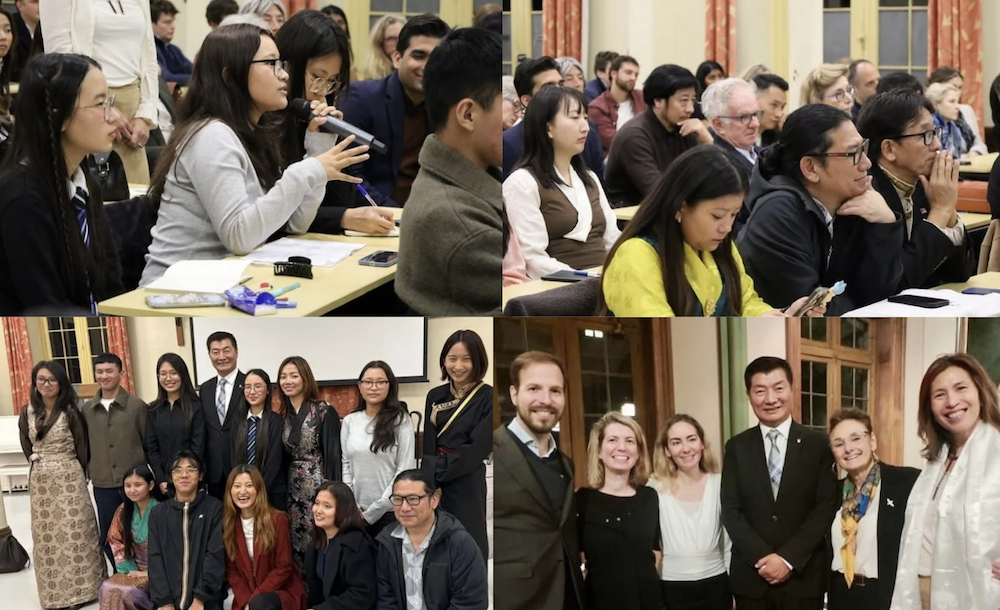
Failloux also highlighted the presence of young Tibetan students who attended the event, praising their “courage and conviction” in preserving their culture amid adversity. “Despite the pressure, they are carrying forward his legacy and the fight for their culture’s survival,” she wrote.
Following her post, Dr. Lobsang Sangay responded with words of appreciation and admiration for Failloux’s efforts. “Indeed, Stéphanie was very brave and determined to secure a venue, even after dozens of rejections, whether under self-imposed or external pressure. She was truly a warrior and is now an honorary member of the Tibetan freedom movement,” he wrote on Facebook. “I want to thank the Harvard Club of France for hosting me, and thank each one of you for showing your support and interest in the issue of Tibet.”
“After a dozen venues refused to host the talk, #stephaniemarevafailloux, the president of the Harvard Club of France, persisted, and I was finally able to give the talk. In clear defiance of Chinese pressure, more than a hundred Harvard alumni and young Tibetans attended and actively contributed to the discussion,” he shared on Instagram.
The reluctance of French institutions to host Dr. Sangay echoes a broader pattern of deference to Chinese sensitivities. In September, the UN Special Rapporteur on Cultural Rights voiced concern over Beijing’s growing influence in the removal of the term “Tibet” from French museum exhibits. While the Musée du quai Branly ultimately reinstated the word “Tibet” in its catalogues and exhibition labels for Tibetan artefacts following public outcry, Yannick Lintz, director of the Musée Guimet, refused to rename its exhibition “Himalayan World” to accurately reflect “Tibet.
The French Harvard Club’s decision to go ahead with Dr. Sangay’s talk, despite institutional hesitation, stands out as an act of moral courage in this climate. As Failloux concluded, invoking Harvard’s motto Veritas (truth): “Peace and justice will never be achieved unless we have the courage to stand by our values.”


Thank you for the information
Lobsang Sangay need not concern himself with matters relating to His Holiness the Dalai Lama’s reincarnation. While he may attempt to frame this as a critical issue for discussion, the reality suggests otherwise. His repeated emphasis on the topic appears more an effort to draw attention to himself or to position for future influence than a genuine expression of concern. The question of His Holiness’ reincarnation is a deeply spiritual matter that lies far beyond political reach, and any aspiration to leverage it for personal or political gain is both misguided and futile. The Tibetan people’s faith and devotion to His Holiness transcend individual ambitions, and no one can assume leadership by exploiting such sacred subjects.
This is not a new phenomenon. Already when HH Dalai Lama visited Sweden in 1988 – one year before the Nobel Peace Prize – the Swedish Foreign Office tried to sabotage the visit by persuading people not to meet him and persuading varioius venues not to host him. We were told this by some of the people who were contacted. We complained about this in the radio news, and the Foreign Office of course denied it. After that their attempts decreased. Years later I met the Foreign Office official who was responsible for this, and he told me that it “wasn’t the best moments in his life”.