

Tenzin Nyidon
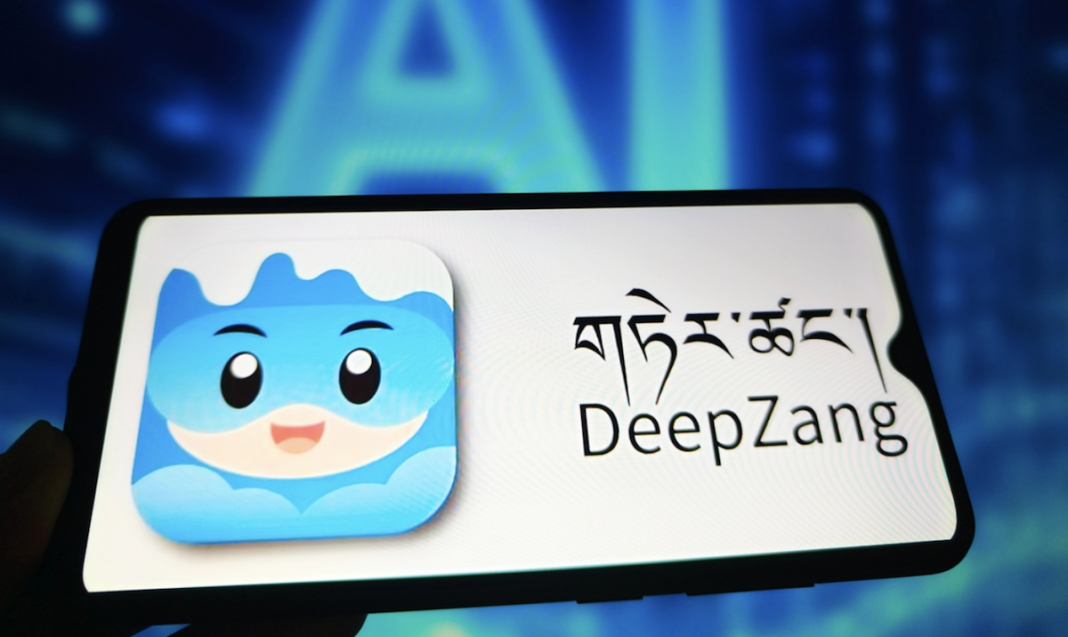
DHARAMSHALA, March 19: China’s unveiling of a Tibetan-language large model, DeepZang, in Lhasa on Monday has been accompanied by bold claims in state media describing it as the “world’s first” Tibetan artificial intelligence platform. Developed by a local company, CHOKNOR, DeepZang is marketed as a large language model (LLM) tailored specifically for Tibetan-language processing, designed to handle tasks such as text generation, translation, and linguistic analysis.
The company’s Chairman Tenzin Norbu stated that the large language model and its applications are intended to offer a credible platform for global users to engage with Tibetan culture, history, and politics, while curbing the spread of what he described as distorted ideologies and narratives.
He further asserted that the model addresses a gap in indigenous large language technologies at both national and ethnic levels and contributes to the preservation and advancement of Tibetan cultural heritage in the age of artificial intelligence.
Highlighting its technical scope, he noted that the open-source platform is presented as China’s first ethnic-language AI system with multilingual and multimodal capabilities. The DeepZang model reportedly supports more than 80 languages, including Tibetan, Putonghua, English, Mongolian, and Uyghur, enabling integrated functions such as speech recognition, translation, comprehension, and interaction.
However, this assertion of primacy is being increasingly challenged by developments from the Tibetan exile community, where Tibetan-language artificial intelligence has already been in active development. The Dharamshala-based Monlam Tibetan IT Research Centre has demonstrated that the integration of Tibetan language into AI systems is neither new nor unprecedented.
At its third annual event held on November 3, 2025, in Dharamshala, the centre announced that its platform, Melong.ai, had surpassed several leading global models, including Gemini, Claude, and DeepSeek, in the Tibetan-language generation and comprehension. This claim highlights a significant advancement in Tibetan-focused AI that predates China’s DeepZang initiative.
Further reinforcing its technological edge, the centre unveiled four major digital tools during its 2025 Monlam Manifestation event at the Tibetan Institute of Performing Arts (TIPA). Among them, “Monlam Think,” an upgraded version of Monlam Melong, stood out for its enhanced ability to analyze and comprehend the Tibetan language with a depth that reportedly exceeds the existing global AI systems.
Melong.ai is both multilingual and multimodal, supporting over 140 languages while accepting inputs in both text and image formats. As part of the Monlam IT team’s broader pioneering efforts, the platform is designed not only to make Tibetan digitally accessible but also to preserve the language and its cultural and intellectual heritage through a distinctly Tibetan perspective.
Monlam AI further offers intelligent tools for research, language learning, and textual analysis. Its capabilities are powered by machine-learning models that support translation, optical character recognition (OCR), speech-to-text, and text-to-speech functions. Currently supporting nine languages, the platform continues to expand its accessibility and usability for a global audience.
In this context, observers argue that China’s portrayal of DeepZang as the first Tibetan AI platform reflects a politically driven narrative rather than a genuine technological milestone.
“China audaciously claims that its DeepZang is the world’s first LLM designed for the Tibetan language. I asked AI to verify this, and it identified MonlamAI, developed by Dharamshala-based Tibetan monk Geshe Monlam, as the first,” wrote Bhuchung K Tsering, Head of the Research & Monitoring Unit at the International Campaign for Tibet, on X (formerly Twitter).
Echoing similar concerns, Sophie Richardson, Co-Executive Director of the Network of Chinese Human Rights Defenders, remarked on X that such portrayals amount to “linguistic erasure presented as a technological wonder in an authoritarian regime’s state-controlled media.”

