

Tenzin Nyidon
DHARAMSHALA, Nov. 11: Nearly four months on the road walking through the unforgiving terrains of the Himalayas surviving primarily on a staple of Tsampa (barley flour), a grassroots Tibetan activist Kalsang Tharchin, arrived in Dharamshala on Wednesday, November 11, after traversing 1600-kilometre solo march from Dharamshala to Leh, the capital of Ladakh and back to raise awareness about the urgent need to preserve the Tibetan language amid growing threats posed by China’s policies in occupied Tibet.
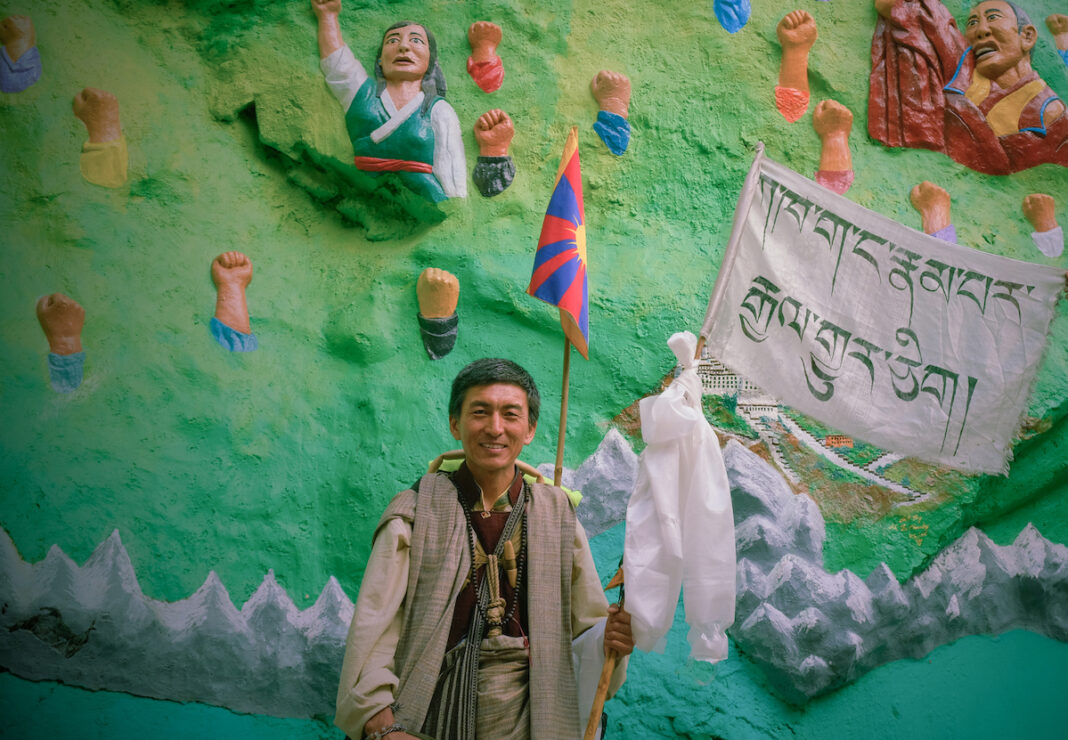
As he placed a ceremonial khatak (white scarf) on the memorial sculpture for the Tibetan martyrs’ near the entrance of the Tsuuglakhnag temple compound here, he let out a momentary burst of tears but retracted his emotions, as he downplayed his ordeal, “Since I am alive and have not sacrificed my life, I feel it is not a cause to feel pride”.
Tharchin began his march on July 15 from Dharamshala, heading towards Leh in Union territory of Ladakh, a region bordering occupied Tibet. He reached Choglamsar Tibetan Settlement there on August 17 after covering approximately 800 kilometres. He subsequently embarked on the return journey on October 8 from Shewatsel Phodrang, His Holiness the Dalai Lama’s residence in Leh, reaching Dharamshala on November 11.
Speaking to Phayul, Tharchin said the march was motivated by concerns over policies implemented by the Chinese government that, he argued, threaten the survival of the Tibetan language and cultural heritage. He also dedicated the journey to the memory of the late Lobga Rangzen, a Tibetan independence activist who self-immolated outside the United Nations Headquarters in New York on July 2.
Tharchin said the campaign was intended not merely as an expression of protest against Chinese policies, but also as a positive appeal for the preservation and protection of the Tibetan language. He particularly raised concerns over China’s Law on Promoting Ethnic Unity and Progress, which came into effect on July 1, 2026, saying its implementation poses further challenges to preserving Tibetan linguistic and cultural identity.
He urged Tibetans, particularly the younger generation, to take greater responsibility for safeguarding their mother tongue. He also called on the wider Tibetan community to initiate campaigns and advocacy efforts demanding the protection of the Tibetan language and cultural heritage.
A white flag carried throughout the journey served as the campaign’s central symbol. It features “Ka Kha Ga Nga,” the first four letters of the Tibetan alphabet, representing the Tibetan language, alongside a message conveying resilience and victory.
Tharchin said the message reflects the broader purpose of his march: to defend the Tibetan language as a fundamental pillar of cultural identity and continuity. He emphasised that preserving the language is itself a form of resistance against policies that threaten to erode Tibet’s cultural heritage.

