

Tenzin Nyidon
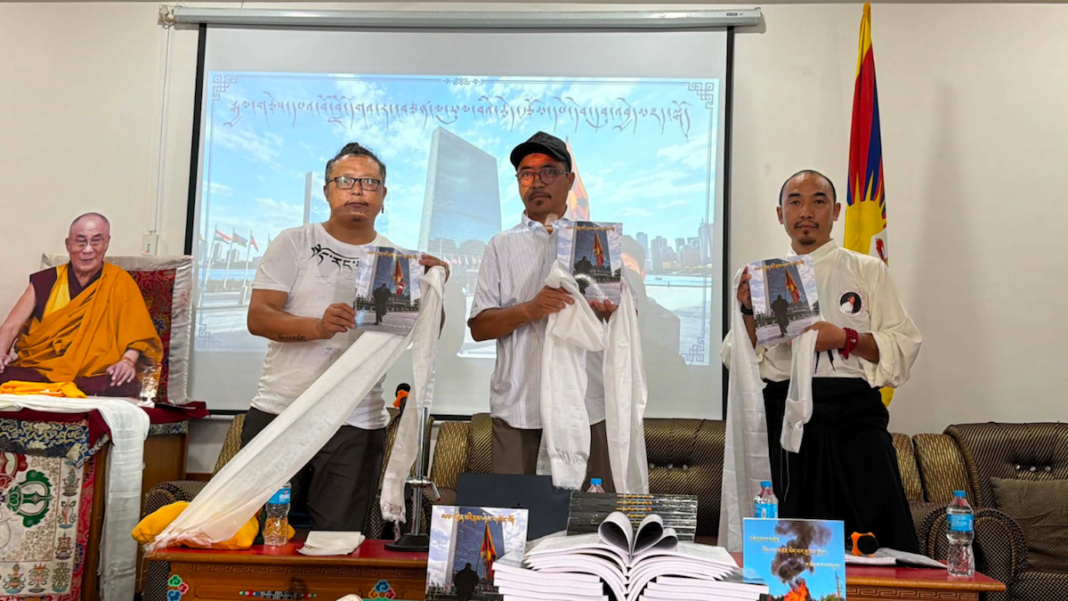
DHARAMSHALA, Sept. 2: Marking two months since the passing of Tibetan independence activist Lobga Rangzen, a collection of 77 essays and prose pieces written by Tibetans in the aftermath of his self-immolation was launched on Wednesday at the Tibetan Settlement Office (TSO) hall in Dharamshala. The volume brings together writings that appeared across social media platforms following Lobga Rangzen’s death, documenting the reflections, emotions, and political sentiments expressed by Tibetans in his memory.
Lobga Rangzen self-immolated on July 2, 2026, outside the UN headquarters in New York. In his message, the late martyr strongly condemned China’s repressive policies in occupied Tibet and its ongoing campaign to assimilate and ultimately erase the Tibetan people. He called on fellow Tibetans that restoration of Tibet’s independence is the only lasting solution to end the sufferings endured under China’s colonial occupation.
Speaking about the motivation behind compiling the book, Loyak Tashi, who compiled the collection, said the idea emerged within a week of Lobga Rangzen’s passing. During that period, he noticed a growing number of essays and prose pieces being written and circulated online in remembrance of the activist. He said Tsering Logye, the editor of the book, approached him and suggested bringing the writings together in a single volume. The conversation prompted him to undertake the compilation, as he feared that many of the tributes and reflections would gradually disappear from public memory within a year or two. He said the book was therefore intended not only to preserve those writings but also to honour what he described as Lobga Rangzen’s “ultimate sacrifice.”
Among the speakers at the launch was Dr Sonam Tobgyal, a researcher at Tibet Watch and an advocate for Tibetan independence, who said he had read most of the pieces in the collection after encountering them on social media. Reflecting on the writings, he said he sensed a renewed expression of support for the Tibetan independence cause among those who had written them. He contrasted this with the situation roughly 15 years ago, when, in his assessment, relatively few Tibetans were paying sustained attention to the independence movement.
While acknowledging that activism around Tibetan independence had continued, he said the past decade had been particularly difficult for advocates of the cause. According to his observation, many activists within the Tibetan community have faced challenges while organising campaigns and advocating for independence at both individual and organisational levels.
He further noted what he described as a growing distance among some Tibetans from the broader Tibetan cause, particularly at times when international governments offered limited support or when the situation inside Tibet deteriorated. However, he said Lobga Rangzen’s self-immolation appeared to have rekindled a sense of urgency and responsibility among sections of the Tibetan community. He said the act had reminded people of the importance of keeping the Tibetan issue alive and continuing efforts on behalf of Tibet.
He also pointed to what he described as a renewed engagement among younger Tibetans, saying that a strong sense of commitment to the independence cause had been largely absent among younger generations for some time. According to him, young Tibetans have often grown up hearing that achieving independence from China is extremely difficult, that China is too powerful, and that Tibetans could benefit by remaining within China. He said discussions about collectively working toward Tibetan independence had consequently received less emphasis in their upbringing and education. He argued that Lobga Rangzen’s self-immolation had helped revive those sentiments across different sections of Tibetan society, with its impact being felt among both younger and older generations.
Another speaker at the launch was Rangzen Dhondup, a close friend of the late activist and president of the Dharamshala regional chapter of the Tibetan Youth Congress (TYC). He said he had known Lobga Rangzen for nearly a decade through their shared involvement in the Tibetan cause.
Recalling the day of Lobga Rangzen’s self-immolation, Rangzen Dhondup said the late martyr had called him at around 10 a.m. IST. At the time, he was attending the annual general meeting of the TYC in Poanta Sahib and was unable to take the call. He instead sent him a message explaining that he was in a meeting and would call him later. He said he could never have imagined that the missed call would come only hours before Lobga Rangzen set himself on fire. He learnt of the self-immolation from a friend early the following morning and said he initially struggled to believe what had happened.
He recalled that Lobga Rangzen had served two consecutive terms with the Tibetan Youth Congress’ New York and New Jersey chapter beginning in 2017, before later becoming involved with the Tibetan National Congress (TNC). Rangzen Dhondup said the two remained in regular contact, frequently discussing campaigns, sharing updates on activities and exchanging ideas on advancing the Tibetan cause. According to him, Lobga Rangzen also consistently supported campaigns organised by the TYC Dharamshala regional chapter, including through financial contributions. He described him as a person deeply committed to preserving Tibetan identity and consistently advocating campaigns in support of Tibetan independence.

