

Tenzin Nyidon
DHARAMSHALA, Feb. 12: For nearly three decades, the Norbulingka Institute in Dharamshala has stood as one of exile Tibet’s most enduring cultural beacons—a living sanctuary where the refined traditions of Tibetan art, once threatened by displacement, found continuity and renewal. Founded in 1995 by Kasur (former minister) Kalsang Yeshi, the institute was conceived not merely as a cultural centre but as a refuge for master artisans, where skills passed down through generations could be preserved, practiced, and transmitted to the future.
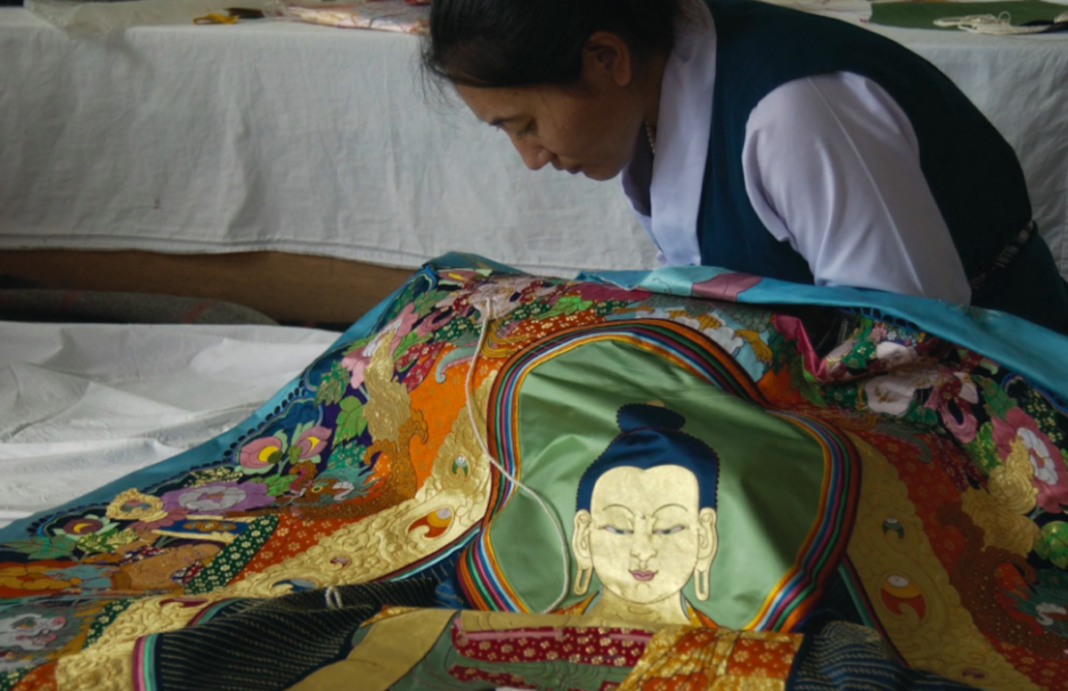
Built on land purchased with the support of funds donated by His Holiness the Dalai Lama, Norbulingka was inaugurated in 1995. Named after the Dalai Lama’s summer palace in Lhasa, the institute soon grew into a premier hub for Tibetan craftsmanship in exile—renowned especially for its thangka paintings, bronze sculptures, woodcarving, appliqué, and traditional furniture-making. Under Kalsang Yeshi’s stewardship, Norbulingka became a rare space where art was not only displayed but lived, with workshops echoing daily with the labor of artisans dedicated to safeguarding Tibet’s artistic heritage.
Over the years, however, the institute’s rhythms began to change. Many of the skilled craftsmen who once filled its workshops gradually moved abroad in search of more stable livelihoods, thinning the artistic community that had long defined Norbulingka’s spirit. Behind its tranquil gardens and meticulously crafted facades, the institute was also grappling with deeper challenges.
In recent months, tensions between Norbulingka’s former management and the Central Tibetan Administration (CTA) leadership came to the fore, marking a turbulent period for the institution. The standoff, which unfolded largely behind closed doors, persisted for months, with reports of internal discord, abrupt resignations, and concerns over governance and finances casting a shadow over one of the exile community’s most revered cultural establishments. Throughout this period, CTA President Penpa Tsering remained largely tight-lipped about the developments unfolding in the background.
Phayul reached out to both the former management of Norbulingka and the CTA President to understand the roots of the discord and the competing narratives surrounding the institute’s administration.
Amid this backdrop of uncertainty, Norbulingka sought to signal renewal. On October 24 and 25, 2025, the institute inaugurated its first-ever Norling Festival, a two-day event that many viewed as an attempt to restore confidence and project a sense of continuity. The festival featured special exhibitions, live art demonstrations, and interactive showcases highlighting Tibetan craftsmanship, and was formally inaugurated by Kyabje Ling Rinpoche. For many observers, the festival appeared to mark a turning point—an assertion that, despite the turbulence of recent months, Norbulingka was seeking to steady itself and reclaim its place as a vital custodian of Tibetan art and culture in exile.
Restructuring at the Top
Earlier this year, Norbulingka underwent what many insiders describe as a “sweeping leadership overhaul.” A new board was constituted with the 7th Kyabje Ling Rinpoche as Chairperson. Former Managing Director Dechen Namgyal Maja and Budget Head Dechen Wangmo both resigned simultaneously, paving the way for former minister Lobsang Nyandak to assume the role of Managing Director on an interim basis.
When Phayul asked CTA President Penpa Tsering, who also sits on the Norbulingka board— what prompted the restructuring, he was cautious yet firm.
“At the outset, I can say that right now, the issue has been resolved, and Norbulingka is back on track,” he said. “I don’t want to go into details of what happened before, but there were lapses we needed to rectify. Every institution must now conform with Indian laws, especially with regard to FCRA regulations if even a single foreigner sits on the board.”
According to the CTA President, the restructuring became necessary following a string of resignations that created what he described as a leadership vacuum. Referring to the departures of Dechen Namgyal Maja and Tsering Phuntsok, he said they “didn’t cite any specific reason for their withdrawal.” He added that the board was reconstituted in April 2024, comprising Kyabje Ling Rinpoche as Chairperson, himself in his capacity as Minister for Religion and Culture, Religion and Culture Secretary Dhondul Dorjee, Library of Tibetan Works and Archives Director Geshe Lhakdor, and former minister Dongchung Ngodup.
However, the sequence of events leading up to the reconstitution of the board remains contested.
In an account shared with Phayul, Kim Yeshi, wife of Kalsang Yeshi, Norbulingka’s longtime Executive Director, painted a very different picture of how the leadership transition unfolded. According to her, tensions emerged even before the spring 2024 board meeting, during routine correspondence between the board and the office of Kyabje Ling Rinpoche.
She said that, as per long-standing practice, Kalsang Yeshi prepared the agenda in consultation with the Managing Director and other board members. When Ling Rinpoche’s office requested a list of attendees, the names were duly shared. However, she said questions arose when Ling Rinpoche asked why former Managing Director Dechen Namgyal Maja was not included. According to Kim Yeshi, it was explained, by either her husband or former minister Karma Gelek Yuthok, that Maja had already stepped down and that his five-year term had expired. “For those two reasons, there was nothing more to it,” she said.
Despite this explanation, she alleged that the issue continued to be raised, and when the board meeting eventually took place, Dechen Namgyal was not invited. Around the same period, she said, her husband himself was removed from the board.
According to Kim Yeshi, Kelsang Yeshi received a dismissal letter in February 2024, prior to the board meeting which was signed by Kyabje Ling Rinpoche. She described the letter as formal and “lawyer-written,” stating that her husband was being dismissed on the grounds that he was unable to carry out his duties, citing “compassionate grounds.”
She said the decision came as a shock, not only to her family but also to other board members. “My husband was a former Kalon Tripa and a senior figure,” she said. “There had never been any hostility. Rinpoche is the tulku of my husband’s former teacher, someone we knew since he was a child. We were completely flabbergasted.”
Kim Yeshi further claimed that several board members resigned in protest following Kalsang Yeshi’s dismissal. “They resigned three days before the board meeting,” she said, suggesting that the resignations were not incidental but directly linked to disagreement over how the decision was made. As a result, she questioned the procedural validity of the meeting itself.
According to her, despite the lack of a majority of sitting board members at that point, new board members were inducted and key decisions were taken. “Without the majority of board members present, the quorum is not met,” she said, adding that under Indian law, a board meeting held without quorum would not be legally valid.
The CTA President, however, maintains that the April 2024 meeting was conducted with a valid quorum and that the board was lawfully reconstituted. He has declined to comment on individual dismissals or internal disagreements, stating that reopening past disputes would not serve the institution. “If we dig up old problems, it creates more problems,” he told Phayul. “Right now things are quiet, and Norbulingka is functioning.”
The contrasting accounts highlight a fundamental point of contention brewing for months about whether the restructuring was a necessary administrative correction carried out within legal bounds, as the CTA President asserts, or whether it unfolded amid procedural ambiguities and internal dissent, as alleged by family members of the institute’s founding leadership.
Audit Errors and Financial Transparency
Concerns over Norbulingka’s financial management intensified after multiple sources told Phayul that at least 12 to 13 errors were flagged in one of the institute’s annual audit reports. The discrepancies raised questions about fiscal oversight at an institution that relies heavily on donor confidence, public goodwill, and government support. Sources further indicated that, in response, the CTA President Penpa Tsering constituted a small internal team from the Department of Religion and Culture to locate and review key documents, including records related to the institute’s ownership and legal status, in an effort to establish greater financial and administrative clarity.
CTA President acknowledged the audit errors but maintained that they did not amount to serious financial wrongdoing. “We looked at all the audit reports,” he said. “These things happen in almost every organization. We didn’t find any major irregularities or misallocation of funds.”
At the same time, he conceded that Norbulingka remains financially vulnerable and dependent on external support. “If not for the support of the Government of India and donations—roughly 50 lakhs and 200 lakhs respectively—Norbulingka would not survive,” he said, noting that business income alone is insufficient to sustain operations.
To address accountability gaps, the CTA President said the current Cabinet is prioritizing strict compliance with Indian law and plans to establish a compliance cell under the CTA’s Finance Department.
Kim Yeshi, however, said the audit concerns reflect long-standing transparency issues rather than isolated accounting lapses. She alleged that financial reporting under former Managing Director Dechen Namgyal Maja was consistently inadequate. “He would never show me the expenditure and income,” she said. “When I asked how much money was spent, that information was never provided.”
Dechen Namgyal rejected these allegations, arguing that the financial weaknesses predated his tenure. He said he was not given proper accounts when he assumed office and inherited an institution under financial strain. “They didn’t give any accounting reports at all,” he said, adding that Norbulingka had limited cash reserves at the time.
Dechen Namgyal maintained that reforms introduced during his tenure, including settling internal borrowings, initiating tax payments, and expanding hospitality ventures, were evidence of improved cash flow rather than mismanagement.
“Had there been an imbalance in cash flow, I could not have improved the institute or started new ventures,” he said.
The contrasting accounts between the CTA’s assessment of minor audit irregularities, allegations of prolonged opacity, and counterclaims of inherited financial weakness emphasise unresolved questions about financial accountability at Norbulingka, even as new compliance measures are now being proposed.
Conflict of Interest Allegations
Perhaps the most contentious issues surrounding the restructuring of the Norbulingka Institute concerns allegations of conflict of interest involving Kalsang Yeshi, Kim Yeshi, and their daughter Sonam Yeshi, who served as the institute’s creative designer.
Sonam Yeshi received royalty payments on designs sold at the Norbulingka store. These royalties were calculated at 10% percentage of every item sold, rather than being paid as a one-time design fee—an arrangement that raised ethical concerns, particularly given Kim Yeshi’s position on the board.
When asked about this arrangement, CTA President Penpa Tsering acknowledged that the setup appeared problematic. “There certainly seemed to be a conflict of interest,” he said. “You had the husband as Executive Director, the wife sitting on the board, and the daughter working as a contractor for design. That was one problem recognized by the board. These will be done away with.”
He confirmed that under the current administration, the institute has discontinued royalty-based payments for designs. “The designers are capable of developing new designs, so we don’t have to pay royalty in the future,” he said, adding that the design work has now been taken over internally.
Asked why such an arrangement had been allowed in the first place, he said it predated the current leadership. “This happened before our time. These were some of the concerns that were expressed, and it’s one among many reasons that led to the restructuring.”
However, Kim Yeshi strongly rejected the characterization of the arrangement as a conflict of interest. Responding to Phayul’s question—which cited the CTA President’s view that having Kasang Yeshi as director, Kim Yeshi on the board, and their daughter as creative designer raised ethical red flags—she said her role on the board was limited.
“I was just his voice at maybe three or four board meetings,” she said, explaining that she sat on the board as a representative during her husband’s tenure. She stressed that her daughter’s role had no bearing on board decisions. “Her being the head of design has nothing to do with the board.”
Kim Yeshi argued that Sonam Yeshi’s appointment was driven by necessity rather than favouritism. She said her daughter returned from the United States in 2007 and was instrumental in building Norbulingka’s design and hospitality sectors at a time when skilled professionals were scarce.
“She created all the designs. Norbulingka didn’t have a choice. It’s not like we had ten designers to choose from,” she said. “She was willing to come back, and she was doing very well for the institute.”
She added that Sonam Yeshi initially worked for a modest stipend and lived at home, describing the arrangement as more of a practical solution than a privileged position. “Considering her level and capacity, it was kind of a favour because we needed somebody to do the work.”
Emphasizing the financial pressures faced by the institute, Kim Yeshi said Norbulingka had to support hundreds of staff and raise substantial monthly revenue through sales and hospitality. “We had 300, then 400 people to support. Norbulingka needed to raise around 300 lakh a month through sales,” she said. “She did the interiors, the hospitality designs—everything. We didn’t have skilled, educated people available at the time.”
Allegations of Privatization Attempts
Adding to the concerns surrounding Norbulingka’s governance, some sources alleged that there had been attempts in the past to privatize the institute, which was established as a public trust under the CTA’s Department of Religion and Culture.
While declining to name individuals, CTA President Penpa Tsering acknowledged that such concerns had been raised.“People felt that those in authority at that time were trying to privatize the institution in the long run, without involving the Religion and Culture Department,” he said.
He stressed that any such move would now be institutionally impossible, noting that future boards would continue to include the Minister and Secretary of Religion and Culture to ensure Norbulingka’s continued linkage with the CTA.
In response, Kim Yeshi rejected the allegation that there was ever an attempt to privatize Norbulingka itself, describing the claims as a mischaracterization of a limited and ultimately abandoned discussion in 2012.
According to her, the issue arose following changes in Indian tax law that required NGOs to pay up to 30 percent tax on profits. At the time, she said, Norbulingka’s business operations, particularly sales, were performing well, and as a non-profit, all revenue was being reinvested back into the institute.“There were no shareholders,” she said. “Everything went back into Norbulingka.”
She explained that legal consultations explored whether separating the business operations from the trust could reduce the tax burden. Under this model, she said, only the commercial arm would be restructured, while ownership of the land, buildings, and the institute itself would remain entirely with the trust.“The idea was not to privatize Norbulingka,” she said, “but to create a business entity dedicated solely to generating income for the trust.”
Kim Yeshi said the proposal never progressed beyond preliminary discussions, largely because of unresolved questions around ownership and management. “We didn’t want to own it,” she said, adding that even the idea of employee shareholding was briefly considered and rejected due to concerns over governance and internal conflict.
She also noted that running such an entity would have required a professionally competent CEO, a role she said she was unwilling to take on. “I didn’t want to run it,” she said. “By that time, I was already out.”
Ultimately, she said the discussion became moot after Norbulingka’s chartered accountant succeeded in restoring the institute’s non-profit tax status, removing the financial incentive for restructuring. “Once that happened, there was no need to pursue it further,” she said. “The idea was shelved because it was no longer necessary.” Kim Yeshi maintained that the privatization proposal never materialized and insisted that Norbulingka’s status as a public trust was never altered.
Pay Disparity Within Staffers
Beyond governance concerns, one of the most pressing internal issues at the Norbulingka Institute is the pay disparity among its staff members. According to CTA President, the imbalance in salaries across departments and roles has been a longstanding problem that the new administration is now seeking to address.
Salary figures shared with Phayul illustrate the extent of the imbalance. While a managing director earns around ₹56,000 per month and a web designer approximately ₹50,000, sales staff earn about ₹17,000. Artisans at the heart of Norbulingka’s cultural mission, particularly tailors, are paid on a piece-rate basis, earning roughly ₹1,000 or more per item depending on the design. Several tailors told Phayul that their average monthly income comes to around ₹10,000, an amount they say is increasingly untenable in the current economy.
“We discovered that some staff were paid disproportionately higher than others,” the CTA President said. “In an institution like Norbulingka, where artisans, painters, and administrators all contribute to its functioning, such gaps can seriously affect morale. We have to ensure that the pay structure is fair and reflects both workload and skill.”
He said the board is in the process of reassessing salary structures with the aim of introducing greater parity and performance-based incentives. “We are working on aligning pay with performance,” he said. “If the institution becomes more profitable, everyone should benefit and not just a few.”
President Penpa Tsering also pointed to broader structural challenges, including staff shortages and declining interest among younger Tibetans in pursuing traditional crafts. “Thangka painting, statue making, appliqué—these require immense patience,” he said. “Unfortunately, many young Tibetans today don’t have the patience or interest. That is another difficulty we must confront if Norbulingka is to survive.”
Kim Yeshi concurred that staff salaries at the institute were “ridiculously low,” particularly for artisans, and said proposals to raise wages had been discussed at board meetings. She said the issue was recognised internally but constrained by the institute’s limited financial capacity.
Former Managing Director Dechen Namgyal Maja also acknowledged the existence of pay disparities but defended the institute’s production-based payment system. According to him, Norbulingka operates more like a business enterprise than a government body and lacks a fixed budget comparable to the CTA.
“Labourers and employees are paid based on their production,” he said. “If we move away from that model, the business units within the institute will not be sustainable.” He cited tailoring as an example, noting that earnings fluctuate depending on output and complexity of work. In his view, income variation is an inherent feature of a production-driven model rather than a reflection of deliberate inequity.
A Promise of a Better Future?
Norbulingka’s turmoil emphasises the delicate balance between preserving cultural heritage and maintaining institutional integrity. As the CTA President put it, “Every organization has its story.” Yet for an institution born out of exile, transparency and accountability are not just administrative requirements. They are moral imperatives.
For now, the CTA President maintains that Norbulingka is “back on track.” Whether this confidence will translate into lasting stability, however, remains to be seen. Beyond governance and finances lies a more fundamental question: can the institute’s new leadership uphold and advance the artistic excellence that once defined Norbulingka? For years, its reputation rested on designs marked by sophistication, ingenuity, and innovation, shaped by artisans including designs by Sonam Yeshi who skillfully and collectively fused traditional Tibetan aesthetics with contemporary sensibilities to meet evolving tastes and market demands. Observers now question whether the current structure can reproduce that level of creative vision, ensuring that Norbulingka continues to be known not merely as a heritage site, but as a living centre of artistic excellence distinguished by the quality and originality of its products.
Uncertainty also lingers over the institute’s ownership and legal status. The CTA President has insisted that Norbulingka falls under the ownership of the CTA’s Department of Religion and Culture. Kim Yeshi, however, has maintained that the institute is, in legal terms, an Indian public trust, albeit one historically associated with the Department of Religion and Culture. “Well, informally it does, but not legally,” she said. “In the bylaws, we were allowed to have up to 30 percent Indian members and 70 percent Tibetan members.” Some observers have noted that, in practice, the board of trustees appeared to lean more closely toward her influence.
As Norbulingka moves forward under renewed leadership, its future remains largely unforeseen. The institute now stands at a crossroads—caught between competing interpretations of ownership, shifting governance structures, and the enduring responsibility to preserve and evolve Tibetan artistic traditions. Whether it can reconcile these tensions while restoring public trust and creative vitality will determine not only its institutional survival, but also its continued relevance as one of exile Tibet’s most important cultural legacies.


In the beginning when nothing is there, nobody cares. It takes a long time to build everything brick by brick, the trees are also grown big and everything looks nice with lots of tourists visiting. Now the ownership problems and people with vested interests who wants to have a piece of the fruits of many years of hard work shows up. And the powers of CTA will appoint their own friends or rather will be a gift position for their hardcore supporters. You can see that from the new board. Congratulations on end of creativity and rise of nepotism.
After reading the articles on Norbu Linka institute, it is very clear we do need some justification. With due respect to all those who are the past members or current new joining members whatever is the situation, we all need to respect all the founding members who work hard from the grass root level. As saying goes: “Rome was not build in one day ” No more finger pointing just make sure Norbu inga is learning institute for Tibetans as well any foreigners who fall under this Nonprofit tax-exempt status facility.
At least Norbulingka now falls under the Department of Religion. It was founded as part of the Department of Religion, but Kalsang Yeshi never gave up on Norbulingka even after his tenure as minister. The Norbulingka institute seemed like the Yeshi family’s private entity for the past few decades. It’s long overdue for the Department of religion to take ownership, and the Yeshi family should grateful for the benefits they’ve received and all the opportunities they’ve had. Thank you CTA President for clean up the mess.
Growing up in Dharamshala in the 1990s, many of us were made to believe that Norbulingka Institute was somehow owned and operated by the family of Kim Yeshi. I am relieved that the facts are now coming to light and that the Institute is once again under the Central Tibetan Administration.
My late father served as a Chitue in the 1980s and later worked for the CTA. Years afterward, when I asked him about the Institute’s ownership, he explained that it had been established with seed funding from His Holiness and that it came under the Choton Department. He also recalled that Kelsang Yeshi used to visit the Tsuglagkhang temple devotedly until the Institute was funded, after which his visits became noticeably less frequent.
Given this context where is the outrage and persistent questioning from the Dhotoe Chithues when it comes to the affairs of the Norbulingka Institute? Kelsang Yeshi, being a Khampa and a former Losel monk, appears to be shielded from the “Chi-gyu Gal-thar” label— when this article makes it clear that the Yeshi family benefited significantly from the Institute, and that there were even attempts to move toward privatizing it.
Talking about transparency, that is lacking even now. Pay gap , still exits. By large margin. Equally under rule and regulation, don’t even mention that. Earlier two of the former foreigners members run it. And now three four top members run it. Same steps but different in narrative. Look more into it and write ok. Don’t jst listen to what Those people says, ask the common people, people of different departments and levels. U will learn the truth. Most of top members cover up all the mistakes and blame on middleman. Look more into this and write .