

By Vijay Kranti
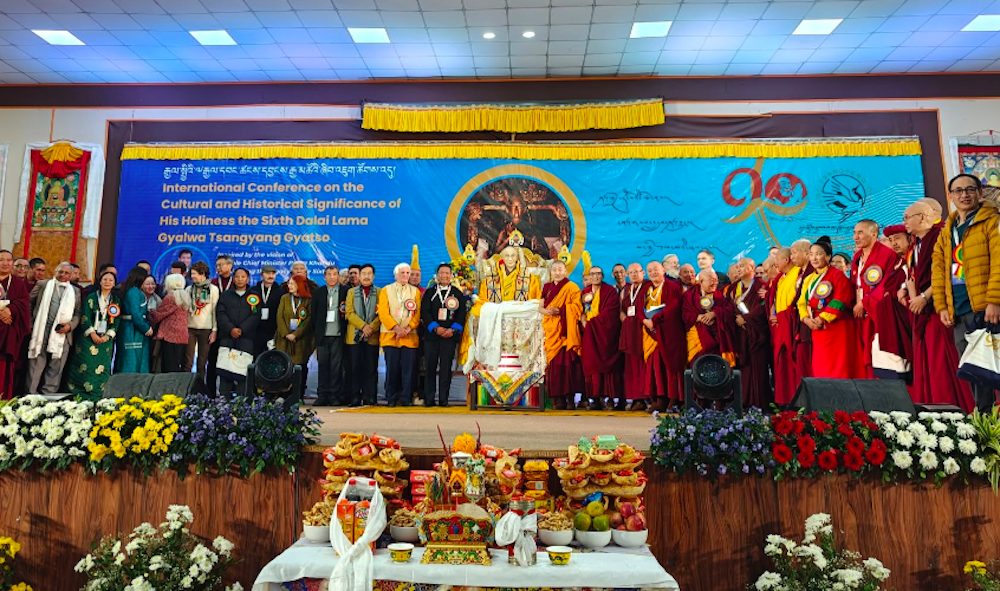
In late November when I received invitation to participate in an international conference on Gyalwa Tsangyang Gyatso, the famous and controversial 6th Dalai Lama at Tawang in Arunachal Pradesh, I alerted some journalist and diplomat friends to watch out for a hot reaction from China soon. I didn’t make this prediction as a fortune teller. It was a simple assessment based on my five decades of observing the China-Tibet-India triangle. But what I could not predict was the level of pungency and anger that Beijing demonstrated to prove me right. Three days after the four-day Tawang conference which had concluded on 6th December, Chinese government posted its reaction on its official ‘China Tibet Online’ site under an aggressive title “Erosion of Sovereignty Under the Guise of Culture: Debunking India’s Absurd Face in Zangnan, Southern Part of Xizang”.
The title itself reflected President Xi Jinping’s desperation to whitewash Chin’s sins in colonized Tibet and to place a respectable veneer over it expansionist plans in South Asia. It was an all-in-one attempt to make the world community to forget China’s colonial occupation of Tibet and change its historically established name to his favorite Chinese name ‘Xizang’ (Just like what China did to ‘East Turkistan’ by renaming it as ‘Xinjiang’ in 1949); to further fortify his claims over India’s Arunachal Pradesh by stating that it is nothing more than a ‘Southern’ part of Tibet’; to dilute Arunachal’s Indian identity by imposing the new Chinese name ‘Zangnan’ on it; and for showing his contempt against the conference by calling it an ‘absurd farce’.
Knowing President Xi’s obsession with claiming Arunachal as a part of China, one was not surprised to see this Chinese commentator, identified only as ‘Yujie’ in the footnote, referring to India’s most popular North-Eastern state as the ‘so-called’ Arunachal Pradesh and its democratically elected and popular leader as its ‘so-called’ Chief Minister. Rather than developing his/her case in a logical manner, this Chinese commentator starts with the claim that India is pursuing a strategy to consolidate its illegal territorial occupation of ‘Zangnan’ through what it calls as ‘cultural encroachment’.
In a later part of the commentary this commentator attempts to fortify China’s claims over Arunachal Pradesh merely on the ground that the 6th Dalai Lama was born in Tawang. Ironically this simply means that any place where a Dalai Lama is reborn in future will automatically become a Chinese territory. One should therefore expect that if present 14th Dalai Lama’s next incarnation is born in Delhi or Washington then China would lay its territorial claims over that capital city too.
During one of my visits to Tibet Autonomous Region (TAR) and those Tibetan regions which were usurped into adjoining Chinese provinces of Yunnan, Sichuan, Qinghai and Gansu following Chinese occupation of Tibet in 1951, I was amused to watch a TV promo in my hotel room which was about a new Chinese mega TV serial on Genghis Khan. It was the same Mongol king who had occupied and enslaved China and many other countries of Asia and Europe to establish the vast Mongol empire which ruled over China for 488 years (1206 to 1634). To my shock, and amusement too, the promo loudly announced Genghis Khan as the “Great Son of China.” Later, as it happened, Beijing tried to persuade many countries to telecast this Chinese TV serial but it was rejected by most of international TV networks. The only exception was the Turkish TV. No wonder China’s new communist historians claim the Mongol rule as the Chinese one and are laying claims over all those areas in Asia and Central Europe as ‘lost Chinese territories’ which were once ruled by the Mongols.
This Chinese communist art of rewriting history to achieve some immediate political goals was once again at its best when the Chinese edition of ‘Tintin in Tibet’ was published in 2015. Originally written and published by famous Belgian author and cartoonist Herge, the Chinese renamed the title of the Chinese language edition as ‘Tintin in China’s Tibet’. No wonder the widow of Herge refused to participate in the much advertised book launch ceremony.
A good reason why China is so angry and frustrated over the Tawang conference is that even though this conference was jointly organized by a group of local Buddhist organizations namely the Thubten Shedrubling Foundation of Tawang and the Centre for Cultural Research and Documentation, Naharlagun under the auspices of the Departmetnt of Karmik and Adhatmik Affairs of the State Government of Arunachal, it was also supported by the International Buddhist Confederation (IBC). The IBC was launched in 2010 by the Indian government to push back China’s attempts to usurp the international Buddhist leadership as the ‘Buddhist Super Power’ of the world. Since 2004 China’s ‘World Buddhist Forum’ (WBF) has organized at least six international Buddhist congregations which hosts about a thousand leading Buddhist gurus and scholars each time from across the world. These congregations have gained more importance and momentum since Xi Jinping took over as China’s superman. It is interesting to note that not only in the spiritual Buddhist matters but also on the commercial front of material goods related to Buddhism China has organized more than 20 editions of its ‘Xiamen International Buddhist Items and Crafts Fair’ since 2006. This has resulted into near total monopoly of China in the world market of goods used in Buddhist temples and homes across the world.
An interesting highlight of China’s WBF congregations is that while the Dalai Lama, the supreme Buddhist Guru of Buddhism has been regularly kept out of these events — just because he lives in exile in India and Beijing condemns him as a ‘splitist’, the Chinese government has been presenting Gyaltsen Norbu, its puppet ‘Panchen Lama’ as the ‘senior most Buddhist leader of the world’. Gyaltsen was installed as the 11th incarnation of the previous Panchen Lama in 1995 after Chinese police arrested Gedhun Choekyi Nyima, the five-year old Tibetan child whom the exiled Dalai Lama had formally acknowledged as the ‘real’ incarnation of the deceased 10th Panchen Lama. Since then the Chinese government has consistently refused to respond to requests of various western Parliaments and human rights groups like the Amnesty International and Human Rights Watch to share information about the safety and whereabouts of Gedhun and his parents.
However, even if China has been trying to present Gyaltsen Norbu as the ‘real’ Panchen Lama and the ‘supreme Buddhist leader of Tibet’, the Tibetan people under the Chinese rule have refused to accept him as their real Guru. Rather, he is despised by ordinary Tibetans as ‘Gyami Panchen’ (Chinese Panchen) and ‘Panchen Zuma’ (Fake Panchen). Recent news from Tashi Lhunpo monastery of Xigatse, the supreme seat of the Panchen Lamas in Tibet, revealed that Chinese authorities used police coercion and cash doles to bring ordinary Tibetans to attend Gyaltsen’s sermons.
The participation of a large number of historians and other experts in the Tawang conference proved quite helpful in clarifying many issues related to the controversies related to the life and personality of the 6th Dalai Lama. Most experts agreed that the Tsangyang Gyatso was quite different from other Dalai Lamas. While wearing both hats as the supreme spiritual leader and temporal master of Tibet, most other Dalai Lamas placed more emphasis on their spiritual practice and teachings than their worldly and physical comfort, the 6th Dalai Lama believed is living a more free private life. As an accomplished poet he composed a number of poems and love songs which presented a refined amalgam of love and spirituality. Many of his poems would remind Hindi readers of famous poet Dr. Harivansh Rai Bachchan for his famous path breaking long poem ‘Madhushala’(meaning: the wine club). While many critics initially condemned him for writing poetry to promote alcohol and alcoholism, it was much later that the audience realized the symbolism of the passage to the pub as the path to ‘Nirvana’ and spiritual enlightenment.
6th Dalai Lama’s songs, addressed to his imaginary lover woman and also about wine are very popular among the people across Tibet even today. It is believed that he used to escape from his magnificent Potala Palace of capital Lhasa to the wine pubs in the lower Shol village. Interestingly, it was mainly because of the writings of some western Christian missionaries like Ippolito Desideri in 1830s and the two-volume anti-religion novel entitled ‘Mahaguru’ by the German radical writer Karl Gutzkone which generated the 6th Dalai Lama’s image as a monk who loved wine and women more than his spiritual duties. The negative image of this supreme religious Guru of Tibet and the Tibetan system was further painted black by the German communist thinker Karl Marx who used ‘Mahaguru’ as his authentic source of information about Tibet to write his leading article in no. 179 edition of the German newspaper ‘Kölniche Zeitung’ . In this article he cited the institution of Dalai Lama of Tibet as an example of totalitarian theocracy representing God on earth. The case of the 6th Dalai Lama is a good example of how the colonialists of Europe of previous centuries used the Christian Church and its missionaries to paint Asian, African, North American and Latin American societies as ‘uncivilized’ and ‘barbarian’ to justify their colonial exploitation and other inhuman colonial acts in these countries.

Interestingly, many researchers presented their own perspectives and findings in this conference about the life, works and history of the 6th Dalai Lama who was born on 1st March 1683 in Tawang and identified as the incarnation of the 5th Dalai Lama in 1685. However due to the Regent Desi Sangay Gyatso’s decision to keep the death of 5th Dalai Lama wrapped in secrecy for 15 years Tsangyang was formally enthroned only at the age of 14 following his secretly guarded upbringing at Tsona, a famous monastery of Tibet across present day Indo-Tibetan border along Arunachal Pradesh. The real controversy and confusion which still prevails is about his life after Lhazang Khan, the Mongol chieftain appointed by the Mongol king Qosot Gushri Khan, deposed the 6th Dalai Lama on 27th June 1706 and ordered sending him to China under Mongol-Manchu captivity. As per one version of history Tsangyang was killed at Drepung near Lhasa when a large crowd of Tibetan lamas tried to rescue him. The other version is that he escaped in the melee and lived an underground and incognito life as a roaming saint who travelled across Tibet, Nepal, China and finally to Mongolia where he died 40 years later in 1746. In an interesting and detailed presentation at this conference Ms. Sangseraima Ujeed, a Professor of Tibetan Buddhism at the University of Michigan, gave details of how, after his escape from Drepung in Tibet, Tsangyang Gyatso finally arrived in Mongolia and spent his life, focused at his spiritual enlightenment and public teaching and died as a legendary spiritual master who is still revered in Mongolia.
Arunachal Chief Minister Mr. Pema Khandu’s inaugural comments at the conference that people of Arunachal Pradesh are proud of the close association of Tawang with two Dalai Lamas only ended up rubbing salt over China’s injured ego over this event. He reminded the participants that not only the 6th Dalai Lama was born in Tawang but the 14th Dalai Lama also entered India through Tawang when he escaped from Chinese occupied Tibet in 1959. In addition to giving a new facelift to the 6th Dalai Lama’s ancestral home in Tawang the Chief Minister also announced the establishment of a special museum in Tawang to present a detailed visual and textual history of Gyalwa Tsewang Gyatso and his family.
What adds to China’s worries about the recent Tawang conference is that the participation of a large number of Buddhist religious Gurus and scholars from internationally reputed institutions and countries as wide as India, Tibet, USA, Japan, Mongolia, Israel, Canada etc. and the international attention it received is bound to weaken China’s case in its claims over Arunachal Pradesh. Also, the successful organization of this conference in Tawang is going to further fortify Arunachal’s place in India’s Buddhist legacy.
(Views expressed are his own)
The author is a veteran Tibet-China watcher and Chairman, Centre for Himalayan Asia Studies and Engagement.


The sixth Dalai Lama is a much loved figure in the annals of Tibetan history and literature. According to Tibetan official history, he died young in his mid-twenties but then there is another school in the secret annals that he lived till his fifties. What has endeared him the most to ordinary Tibetans is his life depicted by himself as an ordinary being who has all the cravings of mundane things such as beautiful woman and romantic rendezvouses. Perhaps the most famous one is this: ཤར་ཕྱོགས་རི་བོའི་རྩེ་ནས་ དཀར་གསལ་ཟླ་བ་ཤར་བྱུང་ མ་སྐྱེས་ཨ་མའི་ཞལ་རས་ ཡིད་ལ་འཁོར་འཁོར་བྱས་བྱུང་
From the summit of the eastern mountains
The white and bright moon is rising
It reminds me of the face of mother who didn’t give me birth (the mother who didn’t give birth refers to his lady love. The bright moon demonstrate the beauty of his lover whose face is like that of a full moon in its full glory).
མཚན་ལྡན་བླ་མའི་དྲུང་དུ་ སེམས་འཁྲིད་ཞུ་བར་ཕྱིན་པས་ སེམས་པ་བསྐོར་ཀྱང་མི་ཐུབ་ བྱམས་པའི་ཕྱོགས་ལ་ཤོར་སོང་
Went to receive meditation lessons from a qualified Lama
Tried to rein in my distractions and concentrated
But my mind was instead wondering away towards Jampa (name of his lady love)
སྒོམ་པ་བླ་མའི་ཞལ་རས་ ཡིད་ལ་འཁོར་རྒྱུ་མི་འདུག་ མ་བསྒོམས་བྱམས་པའི་ཞལ་རས་ ཡིད་ལ་ཝ་ལེ་ཝ་ལེ་
Instead of appearing the face of the Lama in my attempt to meditate upon him,
The face of Jampa is appearing vividly and spontaneously without any effort
སེམས་པ་འདི་ལ་འགྲོ་འགྲོ་ དམ་པའི་ཆོས་ལ་ཕྱིན་ན་ ཚེ་གཅིག་ལུས་གཅིག་ཉིད་ལ་ སངས་རྒྱས་འཐོབ་པར་འདུག་གོ།
If the mind is attracted to the Dharma like being attracted to (Jampa)
There is the possibility to achieve enlightenment in one life time!
བུ་མོ་ཆུང་འདྲིས་བྱམས་པ་ སྤྱང་ཀིའི་རིགས་རྒྱུད་མིན་ནམ་ ཤ་འདྲེས་ལྤགས་འདྲེས་བྱུང་ཡང་ རི་ལ་ཤོར་ཤོར་གྲབས་མཛད་གིས་
Childhood friend Jampa, are you of the same genealogy like that of wolves? Even when we have shared each other’s flesh and skin, you are still tending to run away to the mountains!
One of most famous one is his premonition of returning from Lithang in his next life.
བྱ་དེ་ཁྲུང་ཁྲུང་དཀར་པོ་ གཤོག་རྩལ་ང་ལ་གཡོར་དང་ ཐག་རིང་རྒྱང་ལ་མི་འགྲོ་ ལི་ཐང་བསྐོར་ནས་སླེབ་ཡོང་
White crane, lend me your wings. I will not go far but will return from Lithang.
The seventh Dalai Lama Kalsang Gyatso was born in Kham Lithang.
The stories of the great sages of Tibet like the Dalai Lama’s are fascinating. They often have an ordinary biography and a secret biography. The secret biography of the sixth Dalai Lama is he actually did not die as officially recorded at Lake Koko Nor but in fact he went to India with traders who had a large yak caravan. I think this could be the normal route coming through Nathula in Sikkim. He went around India and wrote this which demonstrate he was in Eastern India.
རྒྱ་གར་ཤར་གྱི་རྨ་བྱ་ ཀོང་ཡུལ་མཐིལ་གྱི་ནེ་ཙོ་ འཁྲུངས་ས་འཁྲུངས་ཡུལ་མི་གཅིག་ འཛོམས་པ་ཆོས་འཁོར་ལྷ་ས།།
The peacock of Eastern India and the parrot of Kongpo may be born in different places but they meet in the holy city of Lhasa. It is alluding to the lovers. They may be born in different countries but love brings them together in matrimony.
This is just a taste of HH Tsang Yang Gyatso’s poetry which are very popular on the lips of every Tibetan in the good old days when Tibet was independent. I believe that He was a pure monk who wrote poetry out of love for the art of poetry. He imagined beautiful Jampa as an inspiration for the poetry to flow in his mind. A beautiful woman is a great inspiration for poetry because she brings a sense of excitement and joy just by her beauty. As English poet John Keats writes in his opening line of Endymion: A thing of beauty is a joy forever! So, the sixth Dalai Lama played with his fantasy or a real woman as an inspiration for the most romantic poems in Tibetan language.