

Tenzin Nyidon
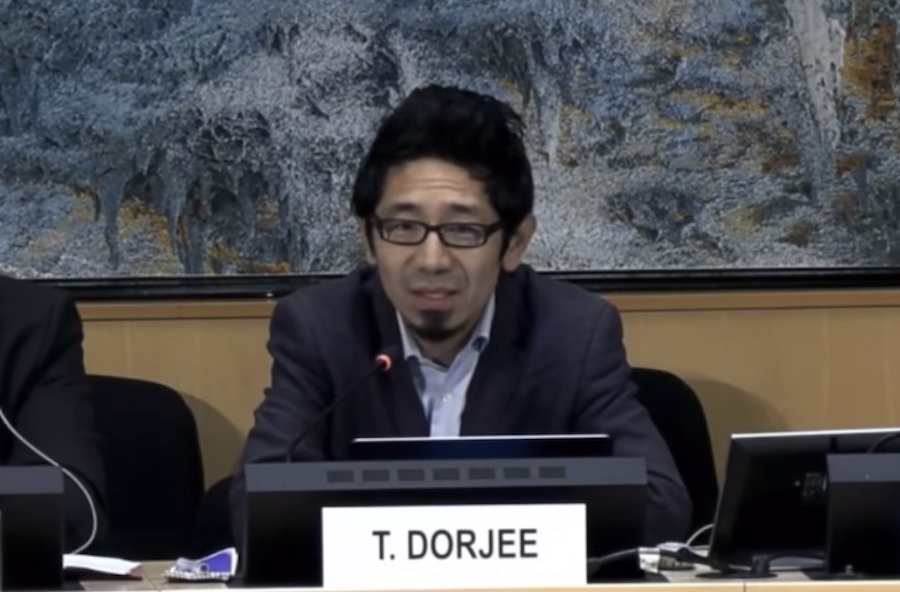
DHARAMSHALA, Dec. 1: In a deeply personal address at the United Nations’ 18th Forum on Minority Issues, Tibet Action Institute’s Senior Researcher and Strategist, Tenzin Dorjee, delivered one of the most forceful interventions of the session, using his platform to challenge the very premise of the panel and to reassert a fundamental truth rarely acknowledged in international arenas that the Tibetans are not a minority; they have been minoritized.
Speaking before UN experts, diplomats, and representatives from more than 26 countries, including China, long-time activist began by tracing his own lived experience as a Tibetan refugee in India, a minority student in Delhi, and later an immigrant in the United States. These experiences, he said, shaped his understanding that minorities “do not strain the resources of any state, nor do they threaten the stability of society.” Instead, they enrich societies through food, culture, labor, innovation, and, most importantly, a distinct perspective that offers “a window and a mirror” through which nations can see themselves clearly.
Transitioning from this global lens to the urgent situation in Tibet, Dorjee emphasised that Tibetans, Uyghurs, and Southern Mongolians are not minorities in the conventional sense but rather people with an inherent right to self-determination under international law. Their current status, he argued, is the result of China’s deliberate political project of erasure.
He went on to expose China’s far-reaching colonial assimilationist policies, detailing how Beijing has enforced the mass internment of over a million Uyghurs, imposed sweeping bans on the Mongolian language in Inner Mongolia, and systemically dismantled Tibetan culture through a vast network of colonial boarding schools.
Citing research published by Tibet Action Institute, he highlighted that three out of every four Tibetan children, totalling between 800,000 and 900,000 students aged 6 to 18, are now separated from their families and placed in state-run residential schools where Tibetan language, culture, and identity are systematically stripped away. “These children are being methodically turned into Chinese,” he warned, calling for the closure of these colonial institutions and the reopening of local schools that allow children to be raised within their family and community environments.
He also challenged the flawed assumption, promoted by some governments, that diversity threatens national unity. It is not multiculturalism that breeds instability, he argued, but the forced imposition of cultural homogeneity. “If you have one terrorist, you have a problem,” he said. “If you have a million terrorists, then perhaps you are the problem,” noting that repression, not diversity, is what fuels radicalization and secessionist sentiment.
Despite two attempts by the Chinese delegation to interrupt his remarks, Dorjee persisted, speaking firmly and without hesitation. His intervention concluded with a call for all states, including the PRC, to uphold the rights of national minorities to maintain and develop their language and cultural practices.
His unwavering delivery and moral clarity were met with rapturous applause from the audience, a rare and remarkable moment in a UN forum where direct criticism of powerful states often elicits silence.

