

By Tsering Dhundup
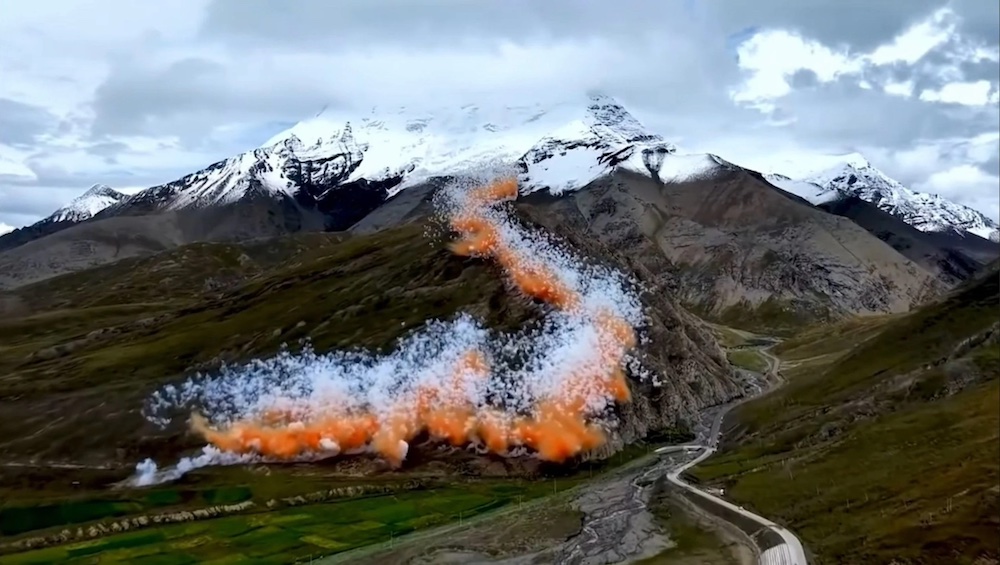
DHARAMSHALA, Oct. 16: An official investigation following widespread public outcry by Shigatse authorities has found that the controversial fireworks display sponsored by Canadian outdoor brand Arc’teryx and designed by Chinese artist Cai Guo-Qiang caused damage to more than 30 hectares (74 acres) of alpine grassland in Gyantse County, Shigatse, Tibet. The investigation led to the dismissal of four local officials and disciplinary action against six others.
The officials sacked include Chen Hao, Communist Party secretary of Gyantse County; Li Jiping, head of the county public security bureau; and two senior officials from the county environmental and natural resources offices. Six additional officials were disciplined and are under further review.
Arc’teryx and Cai Guo-Qiang’s studio, though directly responsible for initiating the stunt, faced only limited consequences. Both were ordered to pay ecological restoration costs but faced no legal charges or operational restrictions.
The 52-second “Rising Dragon” firework display on September 19, which sparked widespread public outcry, involved 1,050 firework pots at altitudes between 4,670 and 5,020 metres (15,350–16,470 feet). The official report described the event as “This incident is a human disturbance activity conducted in a high-altitude ecologically sensitive area,” with scattered debris—including plastic fragments and unburnt powder—and short-term disturbance to local wildlife, including endangered species.
The report further stated that one hectare of soil and vegetation suffered direct damage from trampling, vehicle movements, and land levelling.
At the time, both organisers and local officials defended the event. Arc’teryx claimed the fireworks were biodegradable and that an ecological protection plan had been implemented, including relocating livestock, guiding wildlife away from the site, and cleaning up residues. Cai Guo-Qiang’s studio said the display followed international safety standards used in major events, such as the 2008 and 2022 Beijing Olympics. A local Gyantse ecology bureau official stated that only eco-friendly materials were used, so only local approval was needed rather than a full environmental impact assessment.
However, the official investigation found that the stunt violated China’s 2023 Qinghai–Tibet Plateau Protection Law and was “without collective study or written approval” from county leadership. The report emphasised that while direct short-term pollution was limited, the potential ecological risks require ongoing monitoring and long-term assessment.
The event provoked widespread public backlash, with videos condemning authorities and organisers circulating across social media and garnering millions of views. Environmentalists, Tibetans both inside Tibet and in exile, and concerned Chinese citizens denounced the stunt as a reckless misuse of one of the world’s most fragile ecosystems, highlighting persistent gaps in oversight despite assurances of eco-friendly planning.

